

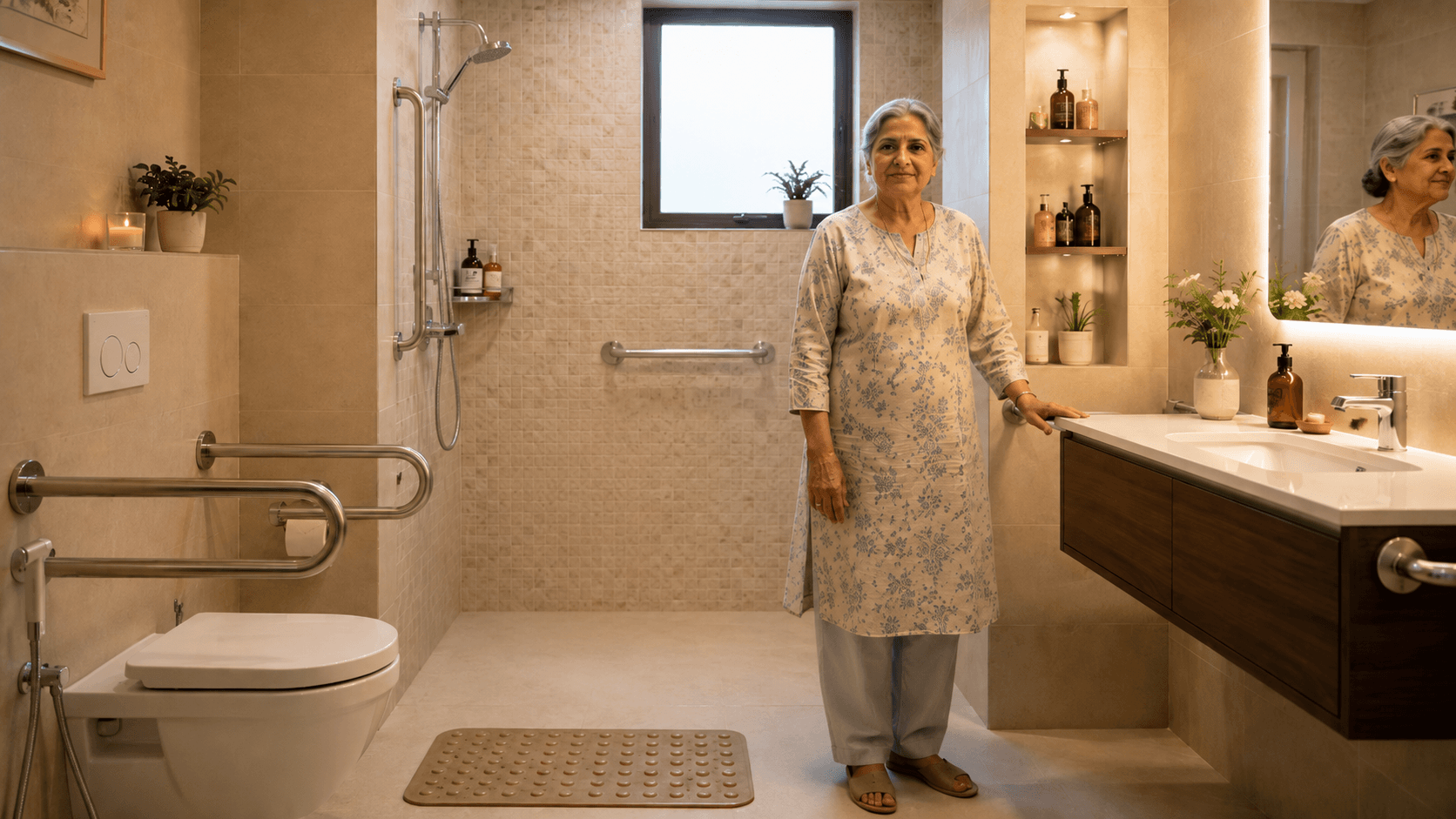
The bathroom is the most dangerous room in the house for anyone over 70. Water, smooth surfaces, and a confined space create the perfect accident environment. In Indian homes, where bathrooms are smaller, wetter, and built differently from Western designs, the risks multiply. Bucket-and-mug bathing creates splashing, the floor stays wet for hours, and drainage is often slower than it should be. If you are going to make one room in your parent's house truly safe, make it this one.
Why Indian bathrooms are uniquely risky for elderly parents
Most Bangalore apartments have bathrooms ranging from 4x6 feet to 6x8 feet. These are compact spaces where a fall leaves nowhere to go. Water usage patterns are different from Western homes: bucket bathing creates constant splashing, the floor stays wet long after bathing is done, and many older homes still have Indian-style squat toilets that become increasingly difficult for seniors with knee or hip problems.
Wet floors are the primary enemy. Not just during bathing. Water drips from wet towels, leaks from buckets, and condensation on walls keeps the floor slippery throughout the day. Fixing this requires both equipment and habit changes.
If your parent needs daily help with bathing, mobility, or routine support, Kareverse can help arrange a trained caretaker at home, starting from ₹1,100/day, with Care Manager oversight and monthly family updates.
Grab bars: the single most effective safety upgrade
A properly mounted grab bar can support a full-grown adult's weight during a slip. A poorly mounted one rips out of the wall and causes the very fall it was meant to prevent. This is the one upgrade where quality and installation matter more than anything else.
Where to install them
- Near the toilet: A horizontal bar on the wall beside the toilet, 33 to 36 inches from the floor, helps with sitting down and standing up. If space allows, install bars on both sides.
- In the bathing area: A vertical bar where your parent steps in and out of the bathing area provides critical support during the highest-risk moment.
- Along the wall near the entrance: A horizontal bar along the longest wall provides a continuous support line for walking across the bathroom.
What to buy and what to avoid
Do not buy suction-cup grab bars. They seem convenient but fail without warning on Indian tile surfaces. Only install stainless steel bars with wall-mounted flanges secured into wall studs or using heavy-duty anchor bolts.
- Standard 24-inch stainless steel grab bars are available at medical equipment stores and online.
- Fold-down grab bars mount to the wall and fold up when not in use, which is ideal for narrow bathrooms.
- Angle-adjustable bars work well for corners and awkward layouts.
Installation matters more than the bar itself. If you are mounting into drywall or a hollow partition (common in newer apartments), standard screws will pull out. Use toggle bolts or molly anchors rated for at least 150 kg. Better yet, hire a professional. A carpenter in Bangalore charges ₹300 to ₹500 to install a bar properly. This is not a place to cut corners.
Anti-slip solutions for wet floors
A wet granite or ceramic tile floor has less friction than you would expect. Your parent does not need to be "unsteady" to fall. Anyone can slip on a wet Indian bathroom floor.
Treatments and mats
- Anti-slip tile treatment is a chemical etching process that roughens the tile surface without any visible change. One treatment lasts 2 to 3 years and costs roughly ₹40 to ₹80 per square foot from local providers in Bangalore.
- Anti-slip mats with suction cups on the underside should be placed in the bathing area and at the entrance. Replace every 6 to 12 months as suction cups degrade.
- Anti-slip adhesive strips are textured tape applied directly to the floor. These work well on existing tiles but must be replaced periodically as the adhesive weakens.
Managing water on the floor
- Install a shower curtain or partition if your parent uses a shower. This contains water to one area instead of letting it spread across the entire floor.
- Keep a dedicated floor squeegee in the bathroom. Teach your parent or the caretaker to pull water toward the drain after every bath. A small squeegee habit prevents expensive hospital visits.
- Check whether the floor slopes properly toward the drain. Many Bangalore apartments have poorly sloped bathroom floors where water pools in corners. If water consistently collects in the same spot, this is a structural issue worth fixing. A civil contractor can re-slope the floor depending on bathroom size.
Shower chairs and seated bathing
The traditional Indian bucket-and-mug bath requires squatting, bending, pouring, and balancing. This sequence of movements becomes increasingly difficult and dangerous with age, arthritis, or balance issues. Transitioning to a seated bathing arrangement is one of the most impactful safety changes you can make.
What to look for in a shower chair
- Aluminium frame with rust-proof coating. Essential in Bangalore's humid climate. Steel frames rust within months.
- Adjustable height so the seat allows feet to rest flat on the floor for stability.
- Rubber-tipped legs to prevent sliding on wet tiles.
- Backrest and armrests for additional support while sitting and standing.
Shower chairs are available at medical equipment stores across Bangalore and online.
Add a handheld shower attachment
If your parent's bathroom still has only a fixed overhead shower or a wall tap, install a handheld showerhead. This allows seated bathing with controlled water flow. A basic model with a wall bracket is available at most hardware stores, and a plumber can install it in about 30 minutes.
Getting your parent to accept the change
Many elderly parents resist giving up bucket bathing. It is what they have done their entire lives. Frame the conversation around comfort, not incapacity. "You can sit and relax instead of squatting" works much better than "You might fall." Start with a simple plastic stool as a trial before investing in a full shower chair. Once they experience the comfort of sitting, acceptance usually follows.
Raised toilet seats and toilet safety
The standard Indian toilet seat height is approximately 15 inches, which is too low for most seniors to sit down and stand up comfortably. The effort required strains knees and hips and creates a fall risk during the transition from sitting to standing.
Options for increasing toilet height
- Raised toilet seat: A plastic seat extender that adds 2 to 6 inches of height to the existing toilet. It clamps onto the bowl without any plumbing changes.
- Toilet safety frame: A metal frame that surrounds the toilet with armrests, providing support for lowering and rising. Particularly useful for seniors with significant weakness or balance issues.
- Combined raised seat with arms: Added height plus support rails in one unit.
If your parent still uses a squat toilet
If your parent uses an Indian-style squat toilet, the situation needs more careful handling. Squatting requires significant knee and hip flexibility that most seniors over 75 simply do not have. A commode chair, which is a portable toilet with a bucket underneath, placed in the bathroom or an adjacent room may be necessary. This is a difficult conversation for many families, but continuing to force a parent with knee arthritis to squat is asking for a fall or a joint injury.
Making small Bangalore bathrooms work
Many apartments across Bangalore have bathrooms under 30 square feet. Fitting safety equipment without making the space unusable requires some creativity.
- Use fold-down grab bars that stay flat against the wall when not in use.
- Choose a foldable shower chair that can be hung on a wall hook or stored outside the bathroom after use.
- Install corner shelves rather than floor-standing storage to maximise walking space.
- Consider a wall-mounted sink to replace a floor-standing pedestal. This frees several square feet of floor area.
- Replace an inward-swinging door with a sliding or outward-swinging door. If your parent falls against the door, an inward-swinging door traps them inside. A carpenter can modify the door frame for ₹2,000 to ₹5,000.
What does all this cost?
A basic bathroom safety setup, including grab bars, anti-slip mats, a shower stool, and a raised toilet seat, costs approximately ₹3,000 to ₹6,000. A more complete setup with professional anti-slip floor treatment, a quality shower chair, fold-down bars, and door modification runs ₹15,000 to ₹30,000.
Start with grab bars and an anti-slip mat. These two changes alone prevent the majority of bathroom falls. Add a shower chair next, then work through the rest as budget allows.
Start with a ₹999 home safety assessment
Not sure which modifications your parent's bathroom needs? The easiest first step is a professional Kare@home Wellness Assessment Visit for just ₹999. A Kareverse Care Manager visits your parent's home in person, inspects every room including the bathroom, identifies fall risks and safety gaps, and delivers a detailed Family Report within 48 hours with specific, prioritised recommendations.
If daily support is needed, caretaker placement can follow, starting from ₹1,100/day with ongoing Care Manager oversight.
Book a ₹999 Kare@home Assessment Visit
Frequently asked questions
What is the most important bathroom safety change for elderly parents?
Install properly mounted stainless steel grab bars near the toilet and in the bathing area. Grab bars are the single most effective fall-prevention device in the bathroom. Avoid suction-cup models as they fail without warning on Indian tile surfaces.
How do I make a wet bathroom floor less slippery?
Apply an anti-slip chemical treatment to the tile surface (lasts 2 to 3 years, invisible finish), place rubber anti-slip mats with suction cups in the bathing area and at the entrance, and use a floor squeegee after every bath to clear standing water toward the drain.
Should my elderly parent switch from bucket bathing to a shower chair?
Yes. Bucket-and-mug bathing requires squatting, bending, and balancing, all of which become risky with age or joint problems. A shower chair with a handheld showerhead allows seated bathing that is safer and more comfortable. Start with a simple plastic stool as a trial if your parent is hesitant.
Is the standard Indian toilet height safe for seniors?
The standard 15-inch toilet height is too low for most seniors, making sitting down and standing up difficult and risky. A raised toilet seat adds 2 to 6 inches of height and clamps onto the existing bowl without plumbing changes. A toilet safety frame with armrests adds further support.
How much does a bathroom safety setup cost in Bangalore?
A basic setup with grab bars, anti-slip mats, a shower stool, and a raised toilet seat costs ₹3,000 to ₹6,000. A comprehensive setup with professional floor treatment, a quality shower chair, and door modification costs ₹15,000 to ₹30,000. You can also book a ₹999 Kare@home Assessment for a professional evaluation of your parent's bathroom.