

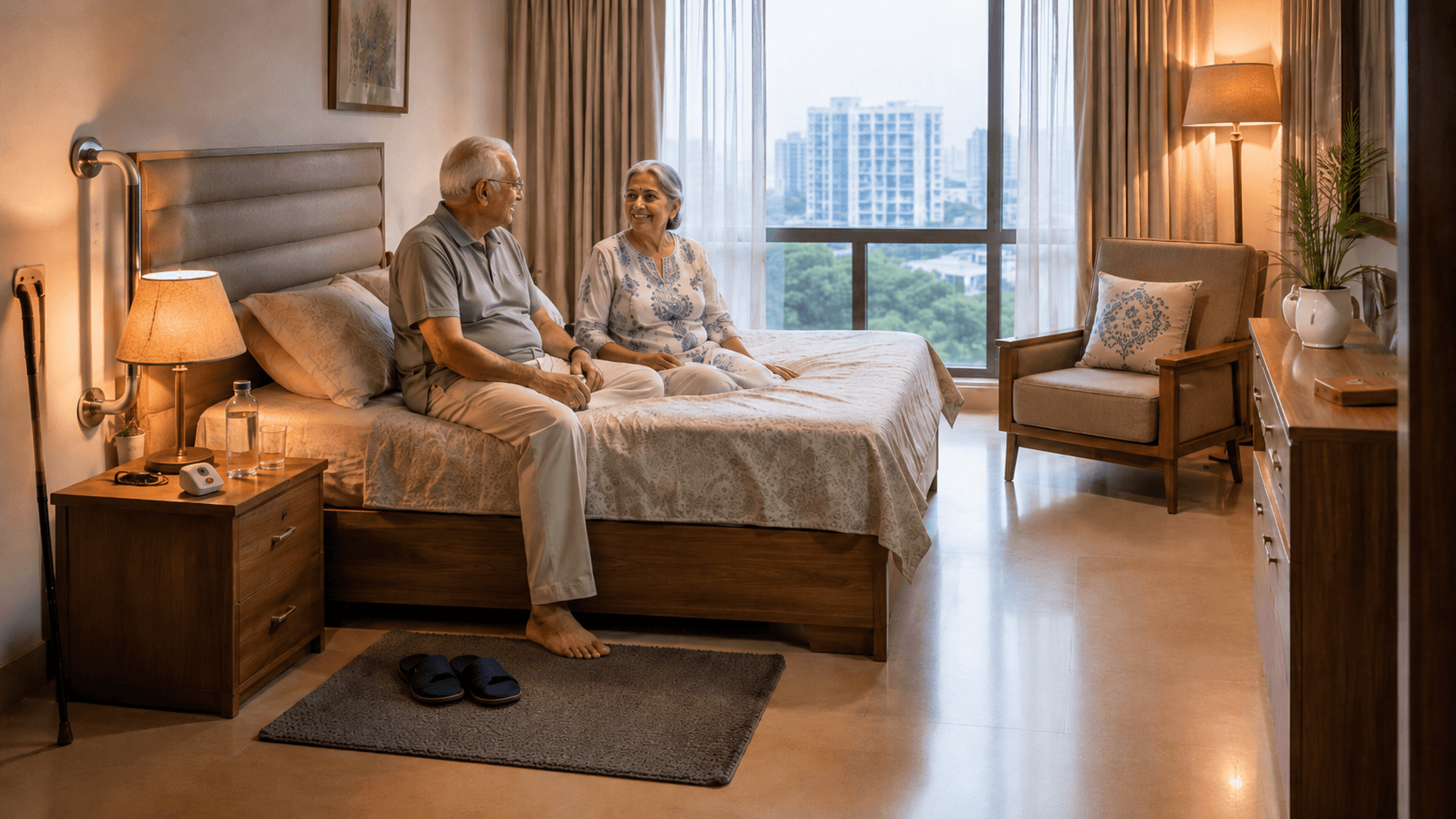
Your Amma woke up at 2 AM to use the bathroom. The tube light flickered twice before turning on. She could not find her chappals in the dark, stepped on a loose rug, and reached for the wall to steady herself. But there was nothing to hold onto. This scene plays out in apartments across Bangalore every single night.
The bedroom is where seniors spend 8 to 10 hours daily, yet it is often the most overlooked space when it comes to safety. It is also where most falls happen: getting in and out of bed, walking to the bathroom at night, or simply reaching for a glass of water on the side table.
Ondondu mane bere bere agirutte (every home is different), but the risks are surprisingly similar. Let us fix them, one step at a time.
Why Bangalore apartments need special attention for senior safety
Most apartments in Bangalore, whether a 30-year-old independent house in JP Nagar or a new gated community in Sarjapur, share common traits that put elderly parents at risk. Bedrooms are compact. The switchboard is frequently on the wrong side of the bed. Storage spaces are either too high (those overhead lofts we all have) or too low (under-bed storage), forcing awkward bending or reaching. The path from bed to bathroom is rarely a straight line, and night-time navigation depends entirely on memory.
Modalu, raatri aa room-nalli neevu omme nadeyiri. (First, walk that room yourself at night.) Turn off all lights and try to reach the bathroom from the bed. Every stubbed toe and missed step your parent experiences is information you can act on.
If your parent needs daily support with mobility, meals, or routine care, Kareverse can help arrange a trained caretaker at home, starting from ₹1,100/day, with Care Manager oversight and monthly family updates.
Lighting: the non-negotiable foundation
Poor lighting is the single biggest cause of bedroom falls. Indian apartments typically have one central ceiling light controlled by a switch near the door, which is useless when your parent is already in bed. And we all know Bangalore's power cuts, even if they are less frequent now. Current hogida mele (once the power goes), your parent is navigating in complete darkness.
What to change right away
- Install a bedside lamp with a big, easy-to-press switch. Avoid touch-sensitive lamps that require precise contact. Rechargeable LED bedside lamps are especially useful during power cuts.
- Add motion-sensor night lights along the path to the bathroom. Place one near the bed, one at the bedroom door, and one inside the bathroom. Look for warm white light (2700K) rather than harsh blue light because it preserves night vision.
- Replace tube lights with LED panels in the ceiling fixture. LED panels light up instantly, unlike CFLs that flicker and take time. Any hardware store in Koramangala or Yeshwantpur stocks these.
- Consider an LED strip under the bed frame. Battery-powered LED strips create a soft floor glow that activates with motion. This is a game-changer if your parent gets up multiple times at night, which many elders do.
Bed height and accessibility: Manchada etthara sariyideya?
A bed that is too low forces seniors to struggle upward, stressing knees and hips. A bed that is too high creates a fall risk when swinging legs down. The ideal bed height allows your parent's feet to rest flat on the floor when sitting on the edge, with knees at approximately 90 degrees.
For most Indian seniors, this means the mattress top should be roughly 45 to 50 cm from the floor.
How to adjust
- If the bed is too low, bed risers fit under existing bed legs and raise the bed by 3 to 6 inches. Available on Amazon India.
- If the bed is too high, removing the box spring or switching to a thinner orthopaedic mattress (5 to 6 inches instead of 8 to 10) can help. Sleepwell and Kurlon both make good options.
- For seniors with significant mobility issues, an electric adjustable bed base allows head and foot elevation. These are an investment, but for parents with chronic back pain, breathing issues, or reflux, they can be genuinely life-changing.
Bedside essentials: keep everything within arm's reach
Everything your parent needs at night should be reachable without getting out of bed or stretching awkwardly. Think of it as a night-time survival kit.
- A sturdy bedside table at bed height, on the side your parent typically sleeps. Put a rubber mat on top so nothing slides off.
- A large-mouthed water bottle with a straw. Easier than a glass that can spill or tip over. Most elders prefer warm water at night, so a good quality flask works well.
- The mobile phone, fully charged every night, with important numbers on speed dial. Write "Emergency" as the contact name for your number and your sibling's number. Namma appa-amma ge phone use madoke ashtu gottilladiddare (if your parents are not phone-savvy), keep it simple: one big button to call you.
- A torch or rechargeable emergency light on the bedside table. Test it monthly because these are forgotten until the transformer blows during a summer storm.
- Any evening or night-time medicines, pre-placed in a labelled pillbox with clear Kannada or English labels, whichever your parent reads more easily.
Clear pathways and floor safety
Bangalore apartments accumulate clutter fast: newspapers, medicine strips, chappals, pooja items, that second walker brought "just in case." Yavude hiriyara maneyannu nodi (look at any elder's room), and you will find at least five things on the floor that should not be there. Every item on the floor is a potential trip hazard at 2 AM.
Creating safe passage
- Remove all rugs and mats that are not non-slip. If your parent insists on a prayer mat or decorative rug, Namma hiriyar jothe vaada maadodu kashta (arguing with our elders is tough), but secure it with double-sided carpet tape or replace it with a rubber-backed mat that grips the floor.
- Maintain a clear 3-foot-wide path from the bed to the bathroom door. This may mean relocating furniture. That extra chair nobody uses can go to the hall.
- Tuck in or remove bedspreads that drape onto the floor. They look nice but are easy to catch a foot on, especially in the dark.
- Keep a stable walking cane or walker next to the bed if your parent uses one. Not across the room. Not in the corner. Right next to the bed, on the side they get up from.
Addressing slippery floors
Polished granite and vitrified tiles, extremely common in Bangalore apartments, are dangerously slippery. Even more so if your parent wears cotton house chappals or walks in socks.
- Anti-slip treatment can be applied to polished floors. Providers in HSR Layout and other areas offer anti-slip coating services. The treatment is invisible but significantly increases grip.
- Replace cotton chappals with rubber-soled footwear. Medical stores stock non-slip diabetic footwear with Velcro straps that are easy to put on and hard to slip out of.
- If replacing flooring is an option, consider matte-finish vitrified tiles or anti-skid tiles. Johnson Tiles and Kajaria both have senior-safe options available at their Bangalore showrooms.
Emergency systems that actually work
When a fall happens at 3 AM, your parent needs a way to call for help immediately. Assuming they will reach their phone is too optimistic. Having multiple backup systems is the only responsible approach. Yochane maadi (think about it): if Amma falls between the bed and the wall, can she reach her phone?
What to set up
- A wireless calling bell placed on the bedside table and another in the bathroom, with the receiver in your room or the caretaker's room. These have a range of 50 to 100 feet, which is enough for most apartments. Test the range in your specific layout.
- A mobile phone in a fixed location every night, plugged into the charger. The location must be identical every single night because muscle memory matters in emergencies.
- For seniors living alone, a medical alert pendant or wristband with a panic button. Some services offer 24/7 monitoring with dispatch and family notification.
- If a full-time caretaker or family member is present, a simple baby monitor works surprisingly well. Audio-only models allow the caretaker to hear if your parent calls out, without feeling intrusive.
Furniture and storage: stop the reaching and bending
Reaching upward causes balance loss. Bending low strains the back. Both are risky for seniors with joint pain, osteoporosis, or balance issues. That top shelf of the godrej almirah that Appa insists on opening himself? That is an accident waiting to happen.
- Move frequently used items to waist-height shelves. Daily medicines, reading glasses, prayer books, and regular clothing should not require reaching up or bending down.
- Replace round drawer knobs with D-shaped pulls that are easier to grip, especially for parents with arthritis.
- Ensure all furniture is stable enough to bear weight. That lightweight folding chair from IKEA will tip over if grabbed during a stumble. Heavy, stable furniture placed along walking paths can serve as informal support points.
- Add a bedroom chair with arms near the wardrobe for dressing and resting. The arms provide leverage for standing up. A sturdy wooden or metal chair makes a meaningful difference.
Adapting to different Bangalore apartment types
Older independent houses (30+ years) across Bangalore often have uneven floors, steps between rooms, and poor original lighting. These require more extensive modification. A professional home wellness assessment can identify risks specific to your home layout and provide a detailed safety report with recommendations.
Modern apartments in Whitefield, Sarjapur, and Electronic City typically have better lighting and level floors but smaller bedrooms. The challenge is fitting safety equipment without cramping the space. Wall-mounted foldable grab bars, slim bedside tables, and under-bed storage on wheels help maximise usable space.
Rented apartments present their own challenge since permanent changes are usually not allowed. Focus on portable, non-damaging solutions: freestanding bed rails, adhesive non-slip strips that can be removed, wireless calling systems, and strategically placed furniture for support.
What does all this cost?
A basic bedroom safety setup, including night lights, non-slip mats, bed risers, a wireless bell, and reorganisation, costs approximately ₹3,000 to ₹5,000. A comprehensive setup with an adjustable bed base, anti-slip floor treatment, medical alert system, and furniture adjustments runs ₹35,000 to ₹60,000.
Start with the basics. Even ₹3,000 of well-chosen changes prevents more falls than you might expect. Modalu chikka badalavanegalinda shuru maadi (start with small changes first), and build from there.
Start with a ₹999 home safety assessment
Not sure where to begin? The easiest first step is a professional Kare@home Wellness Assessment Visit for just ₹999. A Kareverse Care Manager visits your parent's home in person, walks through every room, identifies fall risks and safety gaps, and delivers a detailed Family Report within 48 hours with specific, prioritised recommendations.
If daily support is needed, caretaker placement can follow, starting from ₹1,100/day with ongoing Care Manager oversight.
Book a ₹999 Kare@home Assessment Visit
Frequently asked questions
What is the single most important bedroom safety change for elderly parents?
Install motion-sensor night lights along the path from bed to bathroom. This is the highest-impact, lowest-cost change you can make. Most night-time falls happen because seniors cannot see where they are stepping, and a single night light near the bed can prevent a serious injury.
How high should the bed be for an elderly person?
The ideal bed height allows your parent's feet to rest flat on the floor when sitting on the edge, with knees at approximately 90 degrees. For most Indian seniors, this means the mattress top should be 45 to 50 cm from the floor. Use bed risers or switch to a thinner mattress to adjust.
Are polished granite floors dangerous for elderly parents?
Yes. Polished granite and vitrified tiles are common in Bangalore apartments and become very slippery, especially when wet or if your parent wears cotton chappals. Anti-slip coating treatment, rubber-soled footwear, and non-slip mats along walking paths significantly reduce the risk.
How can I make my rented Bangalore apartment safer for my elderly parent?
Focus on portable, non-damaging solutions. Freestanding bed rails, adhesive non-slip strips that can be removed, wireless calling bells, motion-sensor plug-in night lights, and stable furniture placed along walking paths all work without permanent modifications to the apartment.
What does a bedroom safety setup cost in Bangalore?
A basic setup with night lights, non-slip mats, bed risers, and a wireless calling bell costs ₹3,000 to ₹5,000. A comprehensive setup with an adjustable bed base, floor treatment, and a medical alert system costs ₹35,000 to ₹60,000. Start with the basics and add more as needed, or book a ₹999 Kare@home Assessment for a professional evaluation.