

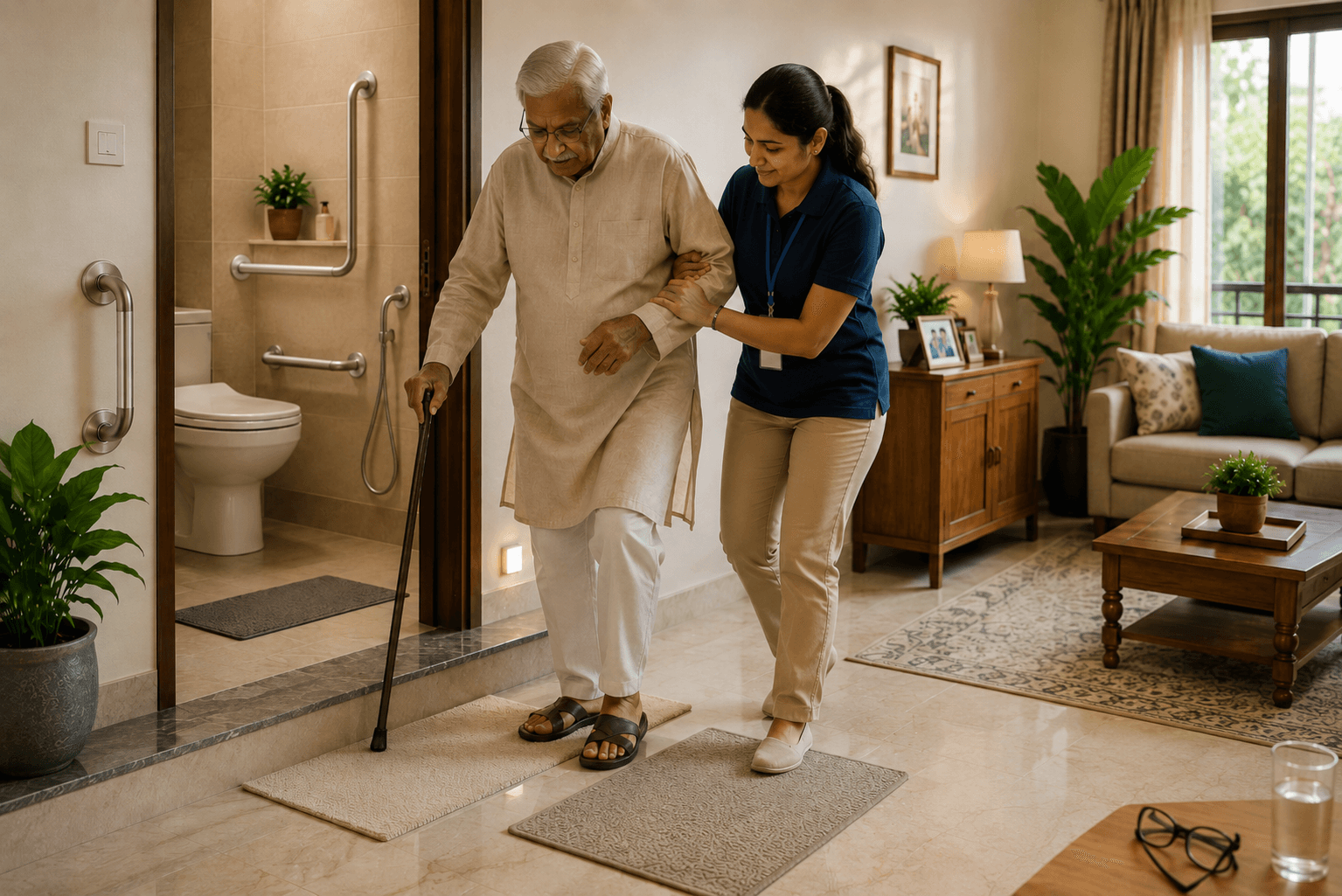
Fall prevention for elderly at home starts with understanding that many falls are preventable. According to the World Health Organization, falls are one of the major causes of injury-related deaths among older adults. In India, research suggests that between 14% and 53% of individuals over 60 experience falls annually. The good news: simple, low-cost home modifications can meaningfully reduce fall risk, especially for elders who already have mobility, balance, vision, or medication-related risks. This guide provides a room-by-room checklist tailored to Indian home layouts — wet bathrooms, mosaic floors, low beds, and kitchen hazards — so you can take action whether you live in Bangalore or abroad.
Why Falls Happen More Often in Indian Homes
Indian homes present unique challenges that increase fall risk for elderly residents. Understanding these factors helps you prioritize the most impactful changes.
Common Risk Factors in Indian Households
Wet bathroom floors are one of the most common and preventable hazards in Indian homes. Traditional Indian bathrooms often have Indian-style toilets requiring squatting, bucket-and-mug bathing that leaves floors wet, and smooth ceramic tiles that become slippery when damp. Research from Pune found that 75.8% of elderly recognize slippery floors as hazards, yet less than half have anti-skid tiles installed.
Poor lighting compounds the problem. A study in rural Tamil Nadu found that 95% of living rooms and 94% of bedrooms had inadequate lighting. During power cuts or dimly lit nights, elderly residents may have to navigate hallways and bathrooms without enough light.
Uneven surfaces are everywhere: the single step at the entrance, raised thresholds between rooms, mosaic or kota stone floors with uneven grouting, and loose rugs placed over smooth tiles.
Low furniture designed for floor sitting becomes hazardous as knees weaken. Beds that are too low, chairs without armrests, and the need to bend for everyday items all increase fall risk.
The Bathroom: A High-Risk Area for Falls
Bathrooms are among the highest-risk areas in Indian homes. The combination of water, smooth tiles, and the physical demands of squatting or bucket bathing can create a serious slip risk.
Essential Bathroom Modifications
Install grab bars beside the toilet and in the bathing area. These typically cost ₹800–2,000 per bar, with installation depending on the wall type and vendor. Unlike towel rods, properly installed grab bars are designed to provide stable support during a slip or loss of balance.
Add non-slip mats both inside and outside the bathing area. Choose quick-drying, rubber-backed mats (₹300–500 each) rather than decorative cotton ones.
Consider a raised toilet seat or portable western commode if your parents use an Indian toilet. A raised toilet seat or portable commode usually costs ₹2,000–5,000 depending on the model and support features. It can reduce the strain and instability caused by squatting.
Install a stable shower stool or shower chair for seated bathing. Basic stools may start around ₹1,000, while safer models with better grip, back support, or arm support can cost ₹1,200–3,500.
Improve drainage and lighting. Ensure the bathroom floor slopes toward the drain and install bright LED lighting.
Bedroom Safety: Preventing Nighttime Falls
Many bedroom falls occur during nighttime bathroom trips, when elderly residents may be disoriented, unsteady after standing, or navigating with poor lighting.
Bed Height and Positioning
The bed should allow feet to rest flat on the floor when sitting on the edge. The ideal height is knee-level—approximately 18–20 inches from floor to mattress top.
Install a grab bar or bed rail on the side of the bed where your parent gets up.
Lighting and Pathway Clearance
Motion-activated nightlights or battery-powered stick-on lights should illuminate the path from bed to bathroom. Budget ₹200–800 per light, or ₹800–2,400 for a 3–4 light setup.
Clear the pathway between bed and bathroom. The path should be at least 3 feet wide and unobstructed.
Keep essentials within arm's reach: water, medications, phone, and a torch on the bedside table.
Living Room and Kitchen: Clearing Hazards
These high-traffic areas accumulate clutter and present tripping hazards that are easy to overlook.
Living Room Modifications
Remove or secure all loose rugs. Secure with double-sided carpet tape (₹200–300) or remove entirely.
Rearrange furniture for clear pathways. Create 3-foot-wide walking paths.
Secure electrical cords along walls using cord covers (₹100–200 per meter).
Add chairs with armrests so your parent can push themselves up.
Kitchen Safety for Seniors
Reorganize storage so daily-use items are at waist-to-shoulder height. Heavy items should sit on the counter, not high shelves.
Clean spills immediately. Indian cooking involves oils and water—both create slip hazards.
Use an anti-fatigue mat where your parent stands to cook (₹800–1,200).
Stairs and Entryways: The Vertical Challenge
A single step at the entrance is easy to miss and is often overlooked during home-safety checks. Indian homes often have stairs without proper safety features.
Staircase Safety Essentials
Install handrails on both sides of the staircase. A short, basic handrail may start around ₹3,000 per side, while longer or custom installations can cost ₹5,000–8,000 or more depending on length, material, and labour.
Apply contrasting tape on step edges (₹50 per step). This helps aging eyes distinguish steps.
Add anti-slip strips on each step (₹30–50 per step), especially on polished granite or marble stairs common in Bangalore homes.
Ensure adequate lighting with switches at both top and bottom.
The "Indian Entry Step" Problem
That single step at the entrance—often painted the same color as the surrounding floor—is invisible to aging eyes. Paint it bright yellow or add LED strip lighting (₹500) to make it visible. If possible, install a small ramp with a handrail for easier access.
Complete Fall Prevention Checklist for Indian Homes
Use this checklist to systematically assess your parents' home. Rate each item: Done / Needs Action / Not Applicable.
| Area | Safety Measure | Priority | Estimated Cost |
|---|---|---|---|
| Bathroom | Install grab bars by toilet and shower | Critical | ₹2,000–4,000 |
| Bathroom | Add non-slip mats inside and outside shower | Critical | ₹600–1,000 |
| Bathroom | Install shower stool for seated bathing | High | ₹1,200–3,500 |
| Bathroom | Consider raised toilet seat or western commode | High | ₹2,000–5,000 |
| Bathroom | Improve drainage and bright LED lighting | High | ₹500–1,000 |
| Bedroom | Adjust bed height to knee level | High | ₹0–2,000 |
| Bedroom | Install motion-activated nightlights | High | ₹800–2,400 |
| Bedroom | Clear pathway from bed to bathroom | Critical | ₹0 |
| Bedroom | Add bed rail or grab bar | Medium | ₹2,500–4,500 |
| Living Room | Remove or secure loose rugs | Critical | ₹200–300 |
| Living Room | Create 3-foot clear pathways | High | ₹0 |
| Living Room | Secure electrical cords along walls | Medium | ₹300–600 |
| Kitchen | Move daily items to waist-height shelves | High | ₹0 |
| Kitchen | Keep heavy items on counter, not high shelves | High | ₹0 |
| Kitchen | Install anti-fatigue mat at cooking area | Medium | ₹800–1,200 |
| Stairs | Install handrails on both sides | Critical | ₹6,000–16,000 |
| Stairs | Apply contrasting tape on step edges | High | ₹300–1,000 |
| Stairs | Add anti-slip strips on each step | High | ₹300–1,500 |
| Entryway | Paint entrance step bright color | Medium | ₹200–500 |
| Whole Home | Install rechargeable emergency lights | High | ₹2,400–4,500 |
Estimated cost for essential fall-prevention changes: ₹15,000–25,000 for basic upgrades. A fuller home-safety setup, including stair rails, bed support, toilet support, emergency lights, and multiple bathroom modifications, may cost ₹25,000–40,000+ depending on the home layout and vendor.
The Kare@home Assessment: Professional Home Safety Evaluation
While this checklist empowers you to make basic changes yourself, a professional assessment provides an expert eye for hazards you might miss. The Kare@home Assessment Visit costs ₹999 and includes a 2-hour home visit by a Care Manager.
During the visit, a Care Manager walks through each room, observes fall-risk areas, checks practical home-safety concerns, reviews medicines and daily routines where relevant, and recommends priority changes for the family.
This is particularly valuable for NRI children or out-of-city family members who cannot visit frequently. After the Kare@home Assessment Visit, the Care Manager sends clear observations and recommendations through the Family Report within 48 hours via WhatsApp.
Frequently Asked Questions
What is the most common cause of falls in elderly at home?
Wet bathroom floors are among the most common and preventable home hazards for elderly people in India. Smooth tiles, water from bucket bathing, poor drainage, and the physical effort of squatting can all increase fall risk. Installing grab bars and non-slip mats addresses this primary hazard.
How much does it cost to fall-proof a home for elderly parents in India?
Basic fall-prevention changes typically cost around ₹15,000–25,000. This may include grab bars, non-slip mats, nightlights, basic bathroom changes, emergency lighting, and securing loose rugs or cords. A more complete home-safety setup, especially one involving stair handrails, bed rails, raised toilet support, shower chairs, or custom installation, may cost ₹25,000–40,000+ depending on the home.
Are grab bars really necessary if my parents are still active?
Yes. Falls often happen suddenly due to a moment of dizziness, a wet spot, or waking up disoriented at night. Grab bars provide something to grab onto during that critical second when balance is lost. They are not a sign of weakness—they are a preventive tool that maintains independence. Install them before they are needed.
What should I do if my parents refuse home modifications?
Start with the least intrusive changes: better lighting (which everyone appreciates), non-slip mats (framed as comfort), and reorganizing frequently used items. Frame modifications as temporary—"let's try it for a month." Involve their doctor, as Indian elders often respect medical authority. Share stories of friends who benefited. During your visit, agree on one or two small changes together and implement them immediately.
How can I assess my parents' home for fall risks if I live abroad?
Ask your parent to walk through each room with their phone camera during a video call, narrating what they see. Watch for them navigating around obstacles. Have them show the bathroom after someone has bathed to spot water accumulation. Alternatively, book a Kare@home Assessment Visit for ₹999. A Care Manager visits your parents at home, reviews practical home-safety concerns, and sends you a detailed Family Report with observations and recommendations within 48 hours.
Fall prevention for elderly at home is not about creating a sterile environment — it is about preserving independence while reducing risk. Small, strategic modifications to your parents' Bangalore home can reduce the risk of fractures, hospitalizations, and the fear that often follows a fall. Whether you implement these changes yourself during your next visit or engage a professional Care Manager to assess and coordinate modifications, the investment of time and money is minimal compared to the cost of a single fall-related injury. For families who cannot be present, Kareverse provides home-safety observations as part of the ₹999 Kare@home Assessment Visit, with a detailed Family Report sent directly to your WhatsApp within 48 hours. Call or WhatsApp +91 90355 54540 to schedule a Kare@home Assessment Visit for your parents in Whitefield, Marathahalli, Indiranagar, Koramangala, HSR Layout, Bellandur, or nearby areas subject to Care Manager availability.