

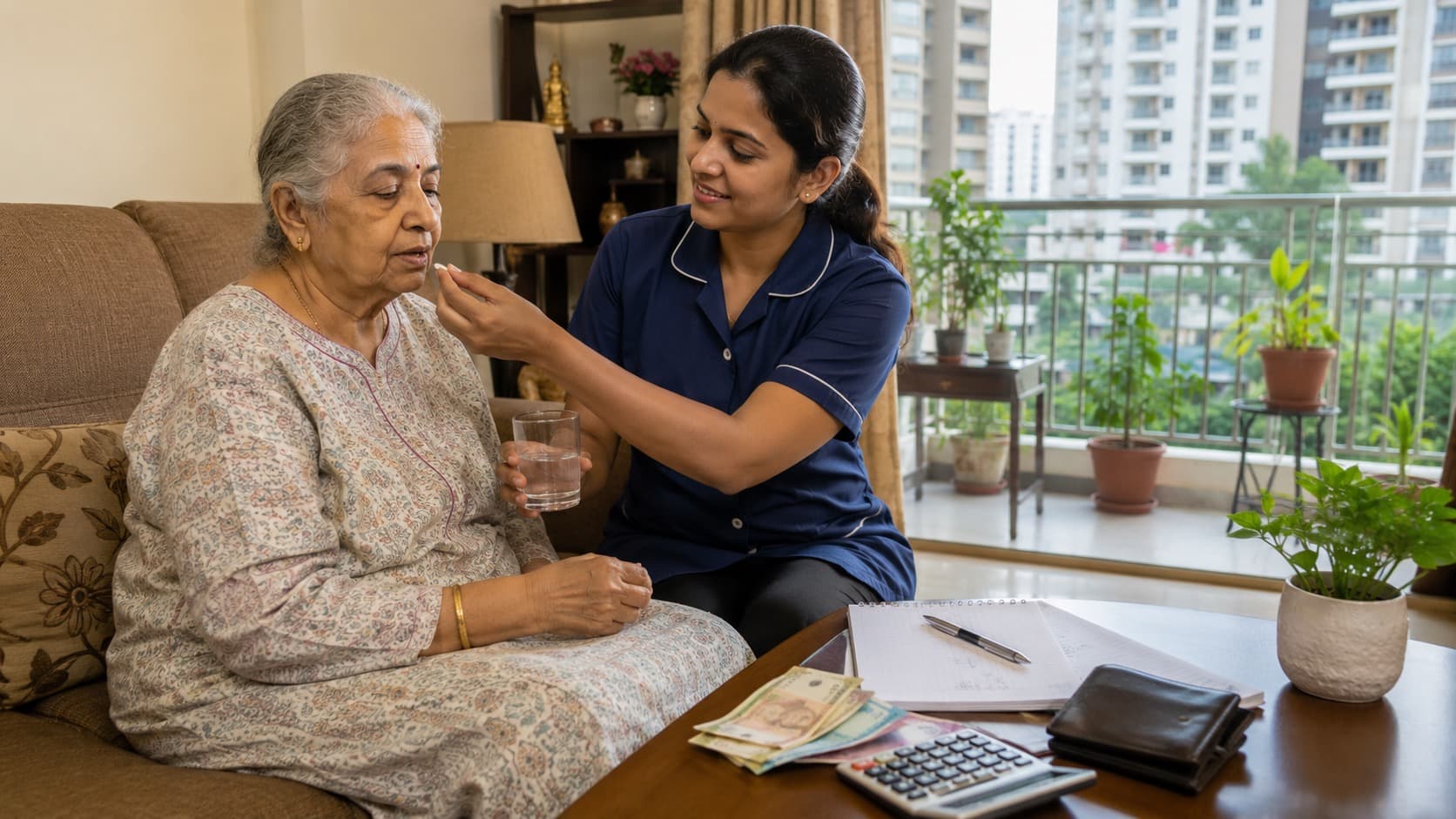
"How much does a home attendant cost per month in Bangalore?" is one of the most common questions families ask when a parent starts needing daily support. It sounds like a simple question. The answer is more complicated than most agencies let on.
This article breaks down the real monthly costs of a home attendant for elderly parents in Bangalore — by attendant type, including the costs most families don't factor in until they're already in the arrangement.
What is a home attendant for the elderly?
A home attendant (also called an attendant, aya, or caretaker) is a person placed at your parent's home to assist with daily physical tasks — bathing, dressing, meals, mobility, medication reminders, and basic companionship. They are not medically trained nurses. For clinical care (wound management, IV administration, catheter care), you need a qualified nurse.
Most families hire a home attendant when a parent can no longer manage daily routines independently — after a fall, post-surgery, or as part of managing a progressive condition like Parkinson's or advanced diabetes.
Cost of a home attendant in Bangalore (2026)
| Type | Daily rate | Monthly estimate |
|---|---|---|
| Trained caregiver | ₹1,100–₹1,200/day | ₹29,000–₹36,000 |
| Semi-trained nurse (ANM) | ₹1,800–₹2,000/day | ₹47,000–₹60,000 |
Day shift (10–12 hrs) and live-in (24 hrs) are charged the same daily rate. For live-in arrangements, food is the only additional cost — typically ₹3,000–₹5,000/month. Monthly estimates are based on 26 working days for day shift and 30 days for live-in.
Trained caregiver: Has completed a short elder care training programme. Can assist with bathing, meals, mobility, medication reminders, basic vital monitoring, and physiotherapy exercises. The right choice for most elderly parents needing daily physical support. Day shift and live-in cost the same per day — the only difference is food for live-in.
Semi-trained nurse (ANM): An Auxiliary Nurse Midwife with basic clinical training. Appropriate for parents needing wound dressing, catheter care, or close vital monitoring — but not for complex clinical needs, which require a registered nurse.
The hidden costs most families miss
The monthly salary is only part of what a home attendant arrangement costs. These are the costs that rarely get mentioned upfront:
Weekly off and replacement: Most caretakers work 6 days a week. The 7th day requires a relief caretaker — either from the same agency at the same daily rate, or managed informally.
Food and accommodation (live-in): A live-in caretaker's food and a place to sleep are typically the family's responsibility. This adds ₹3,000–₹5,000/month depending on the home.
Agency placement fee: Most staffing agencies charge a one-time placement fee of ₹3,000–₹8,000. Some waive this but build it into the monthly cost.
Replacement cost: If an attendant quits or is let go, the agency places a new one — sometimes at another placement fee. High turnover is common in this sector; plan for at least one replacement in the first year.
Supervision gap: This is the most significant hidden cost — not financial, but practical. Once an agency places an attendant, their involvement typically ends. Monitoring the attendant's performance, managing relationship issues, and identifying when care needs change falls entirely on the family. For families managing remotely, this is where arrangements break down.
If you're managing this from outside India
Placing a home attendant for elderly parents when you're living outside India adds a layer of difficulty that most agencies don't prepare you for.
You cannot interview candidates in person. You cannot drop in unannounced to check how things are going. If your parent has a complaint about the attendant, you're mediating it over WhatsApp. If the attendant quits, you're coordinating a replacement from a different time zone.
The questions to ask before placing an attendant remotely:
- Who will conduct the initial needs assessment — you (over a video call) or someone on the ground?
- Who will introduce the attendant to your parent and supervise the first few visits?
- Who do you call if the attendant is unreliable or the fit is wrong?
- Who does the monthly check-in — and is it in writing?
If the honest answer to most of these is "nobody," the placement is riskier than the monthly cost suggests.
Direct placement vs. supervised placement
There are two ways to place a home attendant in Bangalore:
Direct from a staffing agency: You contact an agency, they send candidates, you (or a relative) interview and select one, and the arrangement begins. The agency's involvement ends at placement. Monthly cost: ₹29,000–₹60,000 depending on type, plus placement fee.
Through a care management service: A Care Manager assesses your parent's needs, sources the right attendant, oversees the placement during the trial period, and conducts monthly check-ins. The attendant cost is the same — the addition is a care management layer (typically ₹1,500–₹3,000/month) that monitors performance, handles issues, and sends you written updates.
For families who live nearby and can supervise directly, the agency route is simpler. For families managing from another city or from outside India, the supervision layer is often what determines whether the arrangement lasts.
What should you budget?
Day-shift trained caregiver (10–12 hrs, 6 days/week): ₹29,000–₹32,000/month salary + weekly relief day at the same daily rate
Live-in trained caregiver (24 hrs, 7 days/week): ₹33,000–₹36,000/month salary + food ₹3,000–₹5,000 = ₹36,000–₹41,000/month all-in
Live-in + care management oversight: ₹38,000–₹44,000/month — recommended if you are managing from outside India
Frequently Asked Questions
What is the difference between a home attendant and a home nurse in Bangalore?
A home attendant handles personal care — bathing, meals, mobility, medication reminders. A semi-trained nurse (ANM) has basic clinical training and can handle wound care, catheter care, and vital monitoring. The cost difference is significant: a trained caregiver costs ₹1,100–₹1,200/day, while a semi-trained nurse starts at ₹1,800–₹2,000/day. Most elderly parents need a trained caregiver, not a nurse — unless there is an active clinical need.
Can I hire a home attendant directly without going through an agency?
Yes, but it comes with risks. An agency provides a vetted pool, handles background checks, and can offer replacements. Direct hires may be less expensive but the family absorbs all verification, replacement, and management responsibilities. This is particularly hard to manage from outside India.
How long does it take to place a home attendant in Bangalore?
Through a staffing agency, typically 5–10 days from enquiry to first day. For urgent post-discharge situations, some agencies can deploy within 2–3 days. Expect a trial period of 2–4 weeks before the fit is confirmed.