

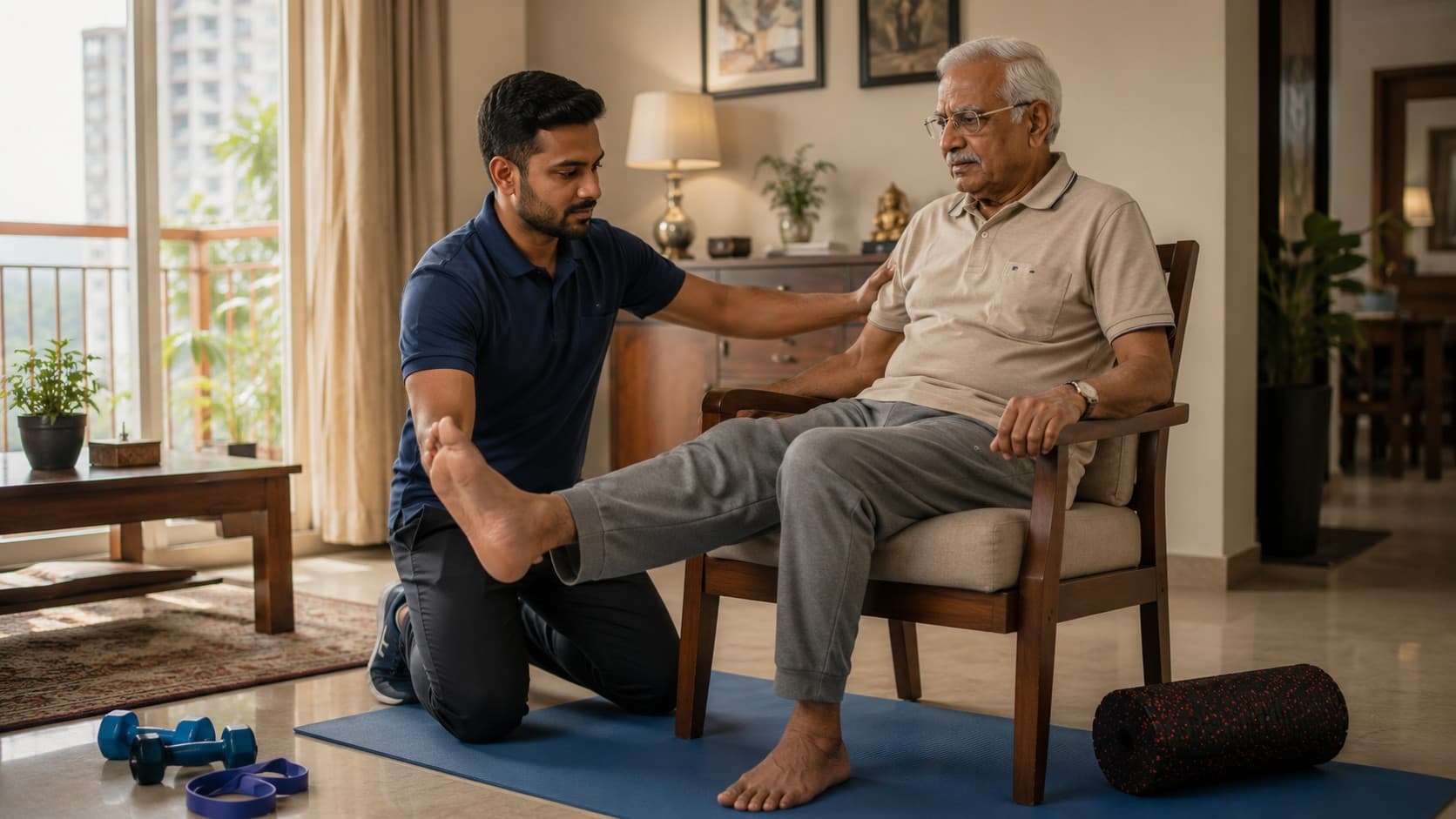
When an elderly parent needs physiotherapy, the hardest part is often not the exercise itself. It is getting the right physiotherapist, making sure the sessions happen regularly, checking whether the exercises are being done safely, and understanding whether there is real progress.
For families in Bangalore, especially adult children who live in another city or abroad, this becomes even harder. A doctor may recommend physiotherapy after a knee replacement, fracture, stroke, fall, or long period of weakness. But once your parent is back home, you may be left wondering: Who will find the physiotherapist? How many sessions are needed? What should each session include? How much should it cost? And how will I know if my parent is actually improving?
This guide explains how physiotherapy at home in Bangalore works, what families should expect, how much it usually costs, and how Kareverse coordinates home physiotherapy for elderly parents.
When should you consider physiotherapy at home?
Home physiotherapy is useful when your parent needs guided movement, strength-building, pain management, balance training, or recovery support but finds it difficult to travel to a clinic.
It is commonly recommended for:
- Post-surgery recovery after knee replacement, hip replacement, fracture repair, or spine-related procedures
- Stroke rehabilitation and neuro-recovery
- Arthritis, spondylitis, back pain, shoulder pain, or chronic joint stiffness
- Parkinson's-related mobility and balance support
- Fall prevention and gait training
- General weakness after hospitalisation, infection, or long bed rest
- Reduced confidence while walking, climbing stairs, or standing up from a chair
For older adults, home physiotherapy is not just about convenience. It also helps the physiotherapist understand the real environment your parent moves in every day — the bed height, bathroom access, staircase, walking space, chair support, and fall risks inside the house.
A clinic can show how a person walks on a flat floor. A home visit can show whether they can safely get from the bedroom to the bathroom at night.
What happens before the first physiotherapy session?
A good home physiotherapy programme should not begin blindly. Before the first session, the physiotherapist or care team should understand your parent's condition, medical history, pain level, mobility level, doctor's advice, and recovery goals.
At Kareverse, the process starts with a free online assessment. A qualified physiotherapist speaks with the family and, where possible, the parent. The aim is to understand what the parent needs help with and recommend the right type of physiotherapy before any home visit is scheduled.
Families should be ready to share:
- The doctor's diagnosis or discharge summary
- Recent surgery or hospitalisation details
- Current pain areas and pain intensity
- Whether the parent can stand, walk, or climb stairs
- Current medications, especially pain medication or blood thinners
- Any history of falls, dizziness, stroke, diabetes, heart disease, or osteoporosis
- The family's main goal: pain relief, walking independently, better balance, recovery after surgery, or daily mobility
This matters because physiotherapy for back pain is very different from physiotherapy after a stroke. A parent recovering from a fracture may need a different pace from someone working on fall prevention. The right plan begins with the right assessment.
What does a home physiotherapy session include?
Every session depends on the condition being treated, but a good session usually follows a clear structure.
The physiotherapist will first check how your parent is feeling that day. If there is unusual pain, swelling, dizziness, breathlessness, fatigue, or discomfort, the session may need to be modified. For elderly patients, physiotherapy should challenge the body safely — not push it beyond what is appropriate.
A typical session may include:
- Gentle warm-up and mobility exercises
- Pain-relief techniques, where appropriate
- Strengthening exercises for weak muscles
- Balance and coordination training
- Walking practice or gait correction
- Sit-to-stand practice, stair practice, or transfer training
- Stretching and range-of-motion work
- Breathing exercises, if needed
- Home exercise instructions for the days between sessions
- Caregiver guidance, if a family member or attendant is present
For post-surgery cases, the focus may be on safely regaining movement, reducing stiffness, restoring strength, and helping the parent return to daily activities.
For stroke rehabilitation, the plan may involve repetitive movement training, balance, posture correction, limb activation, and coordination work.
For arthritis or chronic pain, the aim is usually to reduce pain, improve joint function, build muscle support, and reduce fear of movement.
For fall prevention, the focus is on balance, leg strength, walking confidence, footwear, home safety, and practical movement inside the house.
How many physiotherapy sessions will your parent need?
There is no single answer because physiotherapy depends on age, diagnosis, severity, consistency, and recovery goals.
Some families book 3–5 sessions for mild pain or stiffness and then continue with home exercises. Others may need 10–20 sessions after surgery or fracture recovery. Stroke rehabilitation, Parkinson's support, and major mobility decline often require a longer plan with regular reassessment.
As a broad guide:
For pain management, families may start with 5–7 sessions and review progress.
For post-surgery or fracture recovery, the plan may run for several weeks depending on the doctor's protocol and the parent's progress.
For stroke rehabilitation, consistency matters. Progress can be slow, and families should think in terms of weeks and months rather than a few sessions.
For general mobility decline or fall prevention, regular sessions over a month can help build strength, balance, and confidence.
The important point is not just the number of sessions. It is whether the plan is being reviewed. If your parent is doing the same exercises every session with no progress tracking, the family should ask questions.
How much does physiotherapy at home cost in Bangalore?
The cost of physiotherapy at home in Bangalore depends on the type of condition, the physiotherapist's experience, the session duration, the number of sessions, and whether specialist rehabilitation is required.
At Kareverse, physiotherapy at home currently starts from ₹900 per session.
Here is the current pricing structure:
Pain management — ₹900/session For chronic pain from arthritis, spondylitis, back pain, shoulder pain, or degenerative joint conditions.
General mobility decline — ₹1,000/session For elderly parents who are becoming weaker, walking less confidently, or showing early balance concerns.
Post-surgical or post-fracture recovery — ₹1,200/session For recovery after knee replacement, hip replacement, fracture, or surgery-related mobility restriction.
Stroke rehabilitation — ₹1,200/session For neuro-rehabilitation where consistency, specialist matching, and progress tracking are important.
The final plan depends on assessment. Some parents may need short-term support. Others may need a package with multiple sessions per week. Package recommendations should always be based on the parent's condition — not on a standard sales plan.
Why the cheapest physiotherapy session may not be the best choice
When families search for "physiotherapy at home Bangalore," it is natural to compare session prices. But for elderly care, the cheapest session is not always the safest or most effective option.
What matters is not just whether someone comes home and conducts exercises. What matters is whether the physiotherapist is qualified, whether the plan is appropriate for the condition, whether progress is monitored, and whether the family is kept informed.
Before booking, ask:
- Is the physiotherapist BPT or MPT qualified?
- Do they have experience with elderly patients?
- Have they handled this specific condition before — stroke, post-surgery recovery, arthritis, Parkinson's, or fall prevention?
- Will the same physiotherapist continue across sessions?
- What happens if the fit is not right?
- Will the family receive updates?
- Will the physiotherapist coordinate with the doctor's advice?
- Will the exercises be adjusted based on pain, fatigue, or progress?
For an elderly parent, poor physiotherapy can do more than waste money. It can reduce confidence, increase fear of movement, or lead to unsafe exercise. Good physiotherapy should make the parent feel supported, not overwhelmed.
How Kareverse coordinates physiotherapy at home
Kareverse does not treat physiotherapy as a one-time appointment that is booked and forgotten. The service is coordinated by a Care Manager, so the family has visibility into what is happening.
Here is how it works.
Step 1: Book a free online assessment
You fill in the form or WhatsApp Kareverse. A qualified physiotherapist assesses your parent's condition over a video call and recommends the right session frequency, therapy type, and starting plan.
Step 2: The Care Manager sets up the plan
Your Kareverse Care Manager understands the family's concern, matches the physiotherapist to the condition, confirms the session plan, and schedules home visits at a time that works for your parent.
Step 3: Sessions begin at home
The physiotherapist visits your parent at home. The Care Manager attends the first session to understand the treatment plan, observe the fit, and ensure that the session is appropriate for your parent's needs.
Step 4: Progress is tracked
The family receives updates on how the sessions are going. If your parent is improving, the plan can continue. If the physiotherapist is not the right fit, Kareverse replaces them. If the parent needs additional geriatric or nutrition input, Kareverse can coordinate that as part of the recovery plan.
This is especially useful for NRI families. You may not be in Bangalore to check whether the physiotherapist came, whether your parent cooperated, or whether the session was useful. The Care Manager closes that gap.
Why physiotherapy alone may not be enough for elderly recovery
For older adults, recovery is rarely only about one joint, one surgery, or one exercise sheet.
A parent recovering from knee surgery may also need nutrition support to rebuild strength. A parent recovering from a stroke may need medication review, home safety changes, caregiver training, and regular follow-up. A parent with arthritis may need pain management, strength training, weight management, and safer movement at home.
That is why physiotherapy works best when it is part of a coordinated care plan.
At Kareverse, physiotherapy can be supported with:
- Geriatric consultation
- Nutrition counselling
- Home safety assessment
- Medical equipment coordination
- Doctor visit accompaniment
- Medicine management
- Ongoing Care Manager visits
- Family updates and reports
The aim is not just to complete sessions. The aim is to help your parent recover safely, move with more confidence, and reduce the risk of avoidable decline.
Frequently Asked Questions
How much does physiotherapy at home cost in Bangalore?
At Kareverse, physiotherapy at home starts from ₹900/session for pain management. General mobility support is ₹1,000/session. Post-surgical recovery, post-fracture recovery, and stroke rehabilitation are ₹1,200/session. The final recommendation depends on your parent's condition and session frequency.
Is home physiotherapy better than clinic physiotherapy for elderly parents?
It depends on the case. Clinic physiotherapy may be suitable for mobile patients who can travel safely. Home physiotherapy is often better for elderly parents who have pain, weakness, mobility difficulty, fall risk, post-surgery restrictions, or difficulty travelling. It also allows the physiotherapist to train the parent in the actual home environment.
Do we need a doctor's prescription for home physiotherapy?
A prescription or doctor's note is helpful, especially after surgery, fracture, stroke, or hospitalisation. If you do not have one, start with an assessment. The physiotherapist can review your parent's condition and suggest whether doctor clearance is needed before sessions begin.
How many sessions will my parent need?
It depends on the condition. Pain management may need a short initial plan. Post-surgery recovery may need several weeks. Stroke rehabilitation or major mobility decline may need longer-term support. Kareverse starts with an assessment and recommends the session frequency based on need.
Can physiotherapy help prevent falls?
Yes, physiotherapy can help improve strength, balance, walking confidence, and safer movement patterns. For elderly parents who have started walking slowly, holding walls, avoiding stairs, or fearing movement, balance and mobility training can be important.
Can Kareverse arrange a female physiotherapist?
You can mention the preference while booking. Availability depends on the location, timing, and condition being treated. Kareverse will confirm what is possible before scheduling.
How do I know if the physiotherapist is qualified?
Kareverse works with BPT or MPT qualified physiotherapists. The Care Manager screens the physiotherapist before recommending them and tracks whether the fit is right for your parent.
Can physiotherapy be added to a Kareverse care plan?
Yes. Physiotherapy can be booked as a standalone service. If your parent is already on a Kareverse plan, ongoing session tracking can be coordinated through regular Care Manager visits.
Ready to get started?
Start with a free online physiotherapy assessment. A qualified physiotherapist will understand your parent's condition, recommend the right session plan, and help you decide whether home physiotherapy is the right next step.
If you are unsure whether your parent needs physiotherapy, start with a Kare@home Assessment Visit. A Care Manager visits your parent at home, checks health, medicines, mobility, home safety, nutrition, and emotional wellbeing, and sends you a Family Report within 48 hours.
To book a free physiotherapy assessment or to contact us click here.