

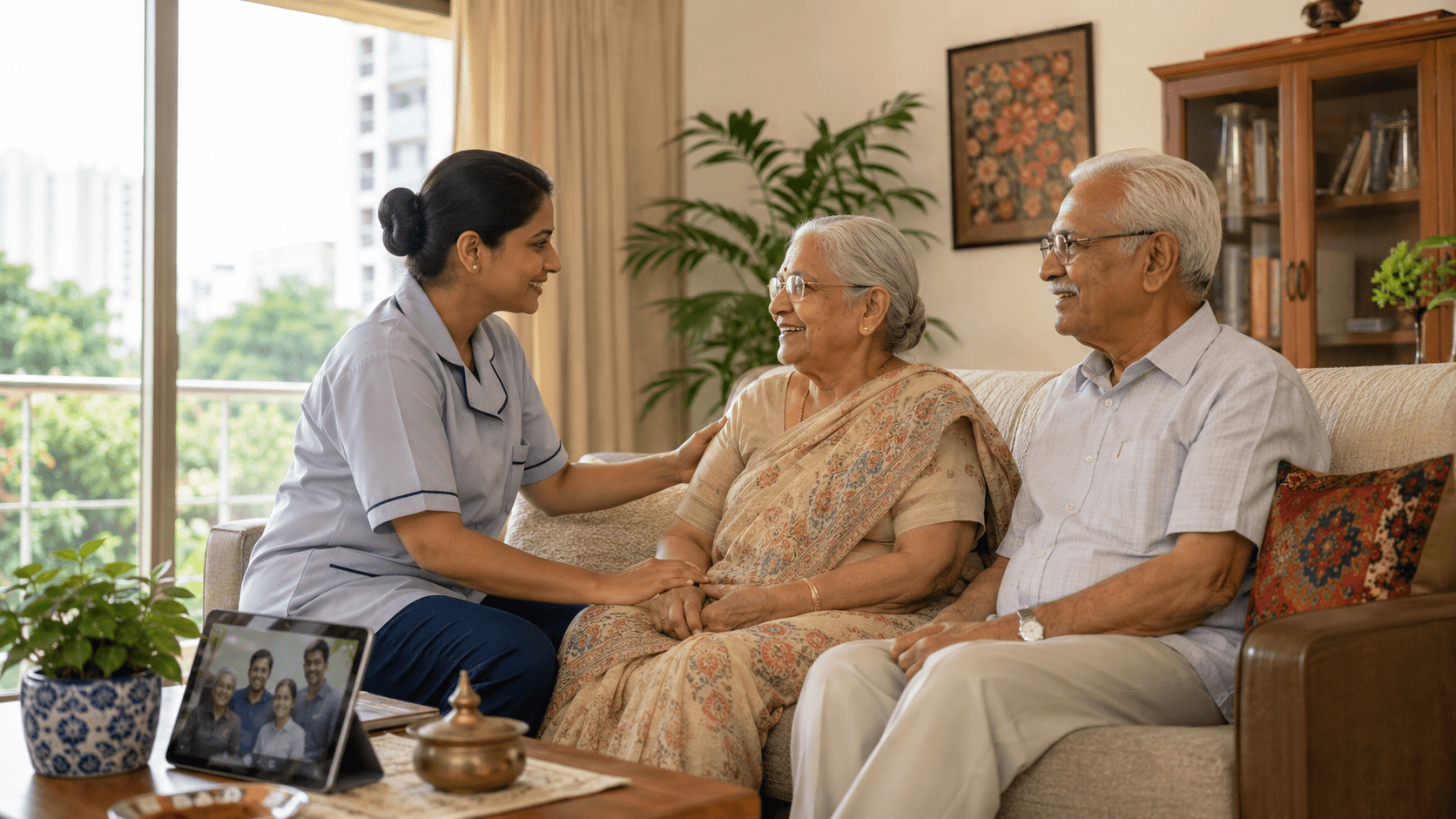
If your elderly parent in Bangalore needs someone at home every day - for help with bathing, meals, mobility, medication, or just being there when you cannot - you are looking for a caretaker. And if you have already started searching, you know the problem is not finding a caretaker. The problem is finding the right one, and knowing they will stay.
This guide is for families - whether you live in Bangalore or abroad - who need a home attendant for elderly parents in Bangalore and want to understand what the process actually involves: what kind of care taker at home to look for, how much it costs, what questions to ask, what can go wrong, and how to set up an arrangement that does not fall apart in the first three months. Whether you are searching for elder care in Bangalore, a caregiver in Bangalore, or home care services in Bangalore - this covers the practical ground.
What does a caretaker for elderly parents actually do?
A caretaker (also called a home attendant, caregiver, or aya) is a person who lives with or visits your parent daily to assist with tasks they can no longer do independently. In Bangalore, elderly care at home through a trained caregiver is the most common alternative to an old age home - and for most families, the preferred one. This is not nursing - a caretaker handles personal and domestic support, not clinical procedures.
A trained caretaker at home in Bangalore typically helps with:
- Personal hygiene: Bathing, grooming, dressing, oral care, toileting assistance
- Mobility support: Helping your parent move between rooms, getting in and out of bed, walking support, wheelchair transfers
- Meal preparation: Cooking or reheating meals, feeding assistance when needed, ensuring adequate water intake
- Medication reminders: Making sure prescribed medicines are taken at the right time and dosage
- Basic vital monitoring: Recording blood pressure, blood sugar, or temperature readings
- Companionship: Being present, engaging in conversation, accompanying on short walks or to the balcony
- Light housekeeping: Keeping the parent's room clean, managing laundry, organising medical supplies
A caretaker does not handle wound dressing, catheter management, IV administration, or post-surgical clinical care. If your parent needs those services, you need a qualified home nurse - which is a different service and cost bracket.
Types of caretakers available in Bangalore
Not all caretakers are the same. The right match depends on your parent's condition, daily routine, and personal comfort.
By training level
Trained caregiver: Has completed a formal elder care training programme (typically 3–6 months). Knows how to assist with safe transfers, fall prevention, basic physiotherapy exercises, and medication management. Costs ₹1,100–₹1,200 per day in Bangalore.
Semi-trained attendant (ANM): An Auxiliary Nurse Midwife with basic clinical training. Can handle wound care, catheter management, and more detailed vital monitoring. Costs ₹1,800–₹2,000 per day. Only needed if your parent has active clinical requirements beyond personal care.
For most elderly parents who need daily support with mobility, meals, and medication - a trained caregiver is the right choice.
By schedule
Day-shift caretaker (10–12 hours): Arrives in the morning, handles personal care routines, meals, medication, and companionship during waking hours. Leaves in the evening. Best for parents who are mobile during the day but need consistent support and supervision.
Live-in caretaker (24 hours): Stays at your parent's home, available around the clock. Essential for parents with advanced mobility issues, dementia, or a history of falls at night. Live-in and day-shift caretakers are charged the same daily rate - the only additional cost for live-in is food and a place to sleep (typically ₹3,000–₹5,000 per month).
Male caretaker vs female caretaker in Bangalore
This is one of the most common questions families ask. The choice depends on your parent's needs and comfort:
When families prefer a female caretaker: Most families default to a female caretaker for elderly mothers - especially for personal hygiene tasks like bathing and dressing. Female caretakers are also more commonly requested for companionship-focused care.
When a male caretaker makes more sense: If your parent requires significant physical support - lifting, wheelchair transfers, walking support for someone who is heavy or unsteady - a male caretaker is often better suited. Male caretakers are also commonly requested for elderly fathers who are uncomfortable with female attendants for personal care.
Availability in Bangalore: Female caretakers outnumber male caretakers in the Bangalore market roughly 3:1. Finding a trained male caretaker in Bangalore can take longer - typically 7–10 days vs 5–7 days for a female caretaker.
The gender of the caretaker matters less than their training, temperament, and experience with your parent's specific condition. A well-matched caretaker of either gender will adapt quickly.
How much does a caretaker cost in Bangalore?
Here is what you should expect to budget in 2026:
| Arrangement | Daily rate | Monthly estimate |
|---|---|---|
| Trained caregiver - day shift | ₹1,100–₹1,200/day | ₹29,000–₹36,000 |
| Trained caregiver - live-in | ₹1,100–₹1,200/day | ₹33,000–₹36,000 + food |
| Semi-trained nurse (ANM) | ₹1,800–₹2,000/day | ₹47,000–₹60,000 |
What is included in the daily rate: The caretaker's salary, their training, and basic agency placement.
What is not included: Food for live-in arrangements (₹3,000–₹5,000/month), weekly off-day relief caretaker (same daily rate), and one-time agency placement fees (₹3,000–₹8,000 at most agencies).
The cost most people miss: Supervision. Once a staffing agency places a caretaker, their involvement usually ends. If the caretaker underperforms, has attendance issues, or the relationship with your parent deteriorates - you are managing it yourself. For families in Bangalore, that means phone calls and drop-ins. For NRI families, it means managing a care arrangement from a different time zone with no eyes on the ground.
For a detailed breakdown including hidden costs and monthly budgets, read our complete cost guide for home attendants in Bangalore.
How to find a caretaker in Bangalore
There are three common ways families find caretakers in Bangalore. Each has trade-offs.
1. Word of mouth and personal references
Asking building associations, local pharmacies, temple networks, or other families in your area. Common in neighbourhoods like Jayanagar, Malleswaram, JP Nagar, and Whitefield where close-knit communities exist.
Pros: No placement fee; someone you know has vetted the person. Cons: Small pool of candidates; no formal background verification; no replacement guarantee if the caretaker leaves.
2. Staffing agencies
Bangalore has dozens of home care staffing agencies that maintain databases of caretakers. You describe your requirements, they send candidates, and you select one.
Pros: Larger pool; some agencies conduct background checks; faster placement. Cons: Quality varies dramatically between agencies; supervision ends after placement; replacement may involve another placement fee; agencies have little incentive to monitor the arrangement once the fee is collected.
3. Managed placement with ongoing oversight
A dedicated person - a Care Manager - assesses your parent's needs, sources caretakers from vetted networks, supervises the placement, and continues checking in monthly. If the fit is not right, the Care Manager handles the replacement.
Pros: End-to-end management; someone accountable after day one; written monthly updates to the family. Cons: Slightly higher monthly cost due to the management layer.
This is the model Kareverse uses for caretaker placement in Bangalore. Your Care Manager visits your parent, assesses their needs, sources candidates with the right training and temperament, supervises the introduction, and stays involved with weekly caretaker check-ins and monthly home visits. If you are managing your parent's care from another city or country, the Care Manager is your eyes and ears on the ground.
What to check before hiring a caretaker
Whether you go through an agency, a managed service, or your own network - these are the things that matter.
Background verification
At minimum, verify:
- Aadhaar identity - confirmed and cross-checked
- Previous employment references - call at least two former families
- Police verification - some agencies provide this; if yours does not, request it
- Health screening - the caretaker should have a recent health check (TB, communicable diseases)
Do not skip background verification because someone "seems trustworthy" or "came through a friend." The person will be alone with your parent for hours every day.
Experience with your parent's condition
A caretaker experienced with post-stroke recovery is different from one experienced with dementia care. Ask specifically:
- What conditions have they managed before?
- Can they handle the physical demands (if your parent needs lifting or transfer support)?
- Are they comfortable with medication management?
- Have they worked with elderly patients who are resistant to help?
Language and temperament
Your parent will spend more time with this person than with almost anyone else. Language compatibility (Kannada, Tamil, Hindi, Telugu, English) and temperament matter as much as training.
Ask: Will your parent be comfortable with this person? Will they be willing to accept help from them? A technically skilled caretaker who your parent refuses to engage with is not a good placement.
Trial period
Never commit to a long-term arrangement without a trial period - ideally 2–4 weeks. During this time, pay close attention to:
- Does the caretaker arrive on time?
- Is your parent comfortable with their presence?
- Are medication schedules being followed?
- Is the caretaker proactive or does your parent have to ask for everything?
Red flags in the first month
Watch for these during the trial period:
- Frequent absences or late arrivals without prior notice
- Phone distraction - spending significant time on their phone instead of being attentive
- Resistance to feedback - a good caretaker adjusts when the family or parent raises a concern
- Gaps in medication compliance - missed doses or inconsistent timing
- Your parent's discomfort - sometimes expressed indirectly ("I don't need anyone" or "they can go")
- Reluctance to communicate - especially with NRI families who depend on regular WhatsApp updates
If you notice these signs, address them early. If the pattern continues, request a replacement before the situation deteriorates.
Why caretaker arrangements fail - and how to prevent it
Most caretaker placements in Bangalore that break down do so within the first 90 days. The common reasons:
Poor matching: The caretaker's skills did not match the parent's actual needs. A companion-level attendant placed with a parent who needs significant physical care will burn out or underperform.
No supervision after placement: The agency placed someone and moved on. Without anyone checking in - on the caretaker's wellbeing and performance - small issues escalate into deal-breakers.
Family-caretaker communication gaps: Expectations are not set clearly at the start. The caretaker does not know what the family considers important. The family does not know what the caretaker finds difficult.
Caretaker burnout: A 24-hour live-in caretaker with no weekly off, no one to talk to, and no one asking how they are doing will leave. It is not a matter of if, but when.
The families who keep caretakers longest are the ones who treat the arrangement as a relationship, not a transaction - and who have someone on the ground managing that relationship consistently.
At Kareverse, the Care Manager fills this role. They check in with the caretaker weekly (not just the family), mediate issues before they escalate, and handle replacements when needed - so you are never starting from scratch. Learn more about how the placement works →
Caretaker in Bangalore for specific situations
Old age care taker at home
For parents who are generally healthy but slowing down - needing help with daily routines, meal preparation, and companionship - an old age care taker at home in Bangalore at ₹1,100/day is usually sufficient. The key is finding someone patient, warm, and consistent. Many families searching for caregivers in Bangalore start here - with a reliable person who shows up every day and builds a rapport with the elder.
Post-surgery or post-discharge care
After a hip replacement, fracture, or hospital stay, your parent may need intensive short-term care - assistance with physiotherapy exercises, wound care monitoring, medication schedules, and mobility. A trained caregiver can handle most of this; for clinical wound care, you may need a semi-trained nurse for the first 2–4 weeks, then step down to a caregiver.
Dementia and cognitive decline
Caretaking for a parent with dementia requires specific skills - patience with repetition, ability to manage wandering behaviour, techniques for calming agitation. Not every caretaker has this experience. Ask specifically about dementia care experience before agreeing to a placement.
NRI families managing from abroad
If you live outside India - in the US, UK, UAE, Singapore, Australia, or Canada - and need home care in Bangalore for elderly parents, the supervision question is your biggest risk. You need someone on the ground who will:
- Visit your parent regularly
- Monitor the caretaker's attendance and performance
- Send you written updates (not just "everything is fine" over WhatsApp)
- Handle replacements without a 2-week gap in care
Talk to a Kareverse Care Manager about caretaker placement →
How Kareverse handles caretaker placement differently
Kareverse is not a staffing agency. We do not maintain a bench of caretakers waiting to be deployed. Instead, here is what happens:
Step 1 - Needs assessment: Your Care Manager visits your parent at home. They assess the level of care needed, note physical requirements (lifting, mobility), language preferences, daily routines, and any medical conditions the caretaker needs to understand.
Step 2 - Sourcing and matching: We source candidates from our vetted partner network of agencies in Bangalore. Every caretaker goes through background verification and reference checks. We shortlist 2–3 candidates matched to your parent's specific profile - not a random available person.
Step 3 - Supervised introduction: The Care Manager introduces the selected caretaker to your parent. The first visit is supervised - to ensure comfort, set expectations, and establish daily routines.
Step 4 - Ongoing oversight: This is where it is different from an agency. Your Care Manager checks in with the caretaker every week. Visits your parent monthly. Sends you a written update every month - covering the caretaker's performance, your parent's wellbeing, and any changes observed. If an issue arises, the Care Manager handles it - you do not manage the caretaker relationship yourself.
What it costs: Trained caregiver placement starts at ₹1,100 per day. Care Manager oversight is included in the Kareverse Care Plan, which starts at ₹4,499 a month when paid annually.
View full caretaker placement details and enquire →
Frequently Asked Questions
How much does a caretaker cost per month in Bangalore?
A trained caregiver for elderly parents in Bangalore costs ₹1,100–₹1,200 per day - approximately ₹29,000–₹36,000 per month depending on day-shift vs live-in. Live-in arrangements add ₹3,000–₹5,000 monthly for food. Semi-trained nurses (ANM) cost ₹1,800–₹2,000 per day. For a full breakdown, see our home attendant cost guide.
How do I find a female caretaker in Bangalore?
Female caretakers in Bangalore are available through staffing agencies, word-of-mouth referrals, and managed placement services like Kareverse. Female caretakers are more commonly available than male caretakers, with typical placement time of 5–7 days. Specify your gender preference during the initial needs assessment so candidates are matched accordingly.
What is the difference between a caretaker, a caregiver, and a home attendant?
In practice, these terms are used interchangeably in Bangalore. A caretaker, caregiver, home attendant, or aya all refer to a person who provides daily personal care support - not clinical nursing. Staffing agencies may use different terms, but the role and cost are the same.
Can I hire a caretaker in Bangalore for just a few weeks?
Yes. Short-term caretaker placements (2–8 weeks) are common for post-surgery recovery, post-discharge care, or while a family member is travelling. Most agencies and managed services charge the same daily rate for short-term placements; some may add a higher placement fee for arrangements under one month.
How do I know if the caretaker is treating my parent well?
If you live nearby, unannounced visits during different times of day are the most reliable check. If you are managing remotely, you need a structured feedback mechanism - regular calls with your parent, periodic calls with the caretaker, and ideally someone who visits and observes in person. Kareverse's Care Manager conducts weekly caretaker check-ins and monthly home visits, with written reports sent to the family.
What should I do if the caretaker suddenly quits?
Sudden departures are common in this industry. If you placed through an agency, contact them immediately for a replacement - most agencies take 5–10 days. If you are with a managed service like Kareverse, the Care Manager begins sourcing a replacement immediately and aims to deploy within 72 hours, coordinating bridging arrangements in the gap.
Is it better to hire a caretaker directly or through an agency in Bangalore?
Direct hiring costs less (₹15,000–₹22,000/month) but you handle background verification, PF, replacements, and supervision entirely yourself. Agencies provide a larger pool and some verification, but ongoing monitoring is minimal. For a detailed comparison of both approaches plus managed placement, read our hiring comparison guide.
Need a caretaker for your elderly parent in Bangalore? Talk to a Kareverse Care Manager on WhatsApp or view our caretaker placement service →