

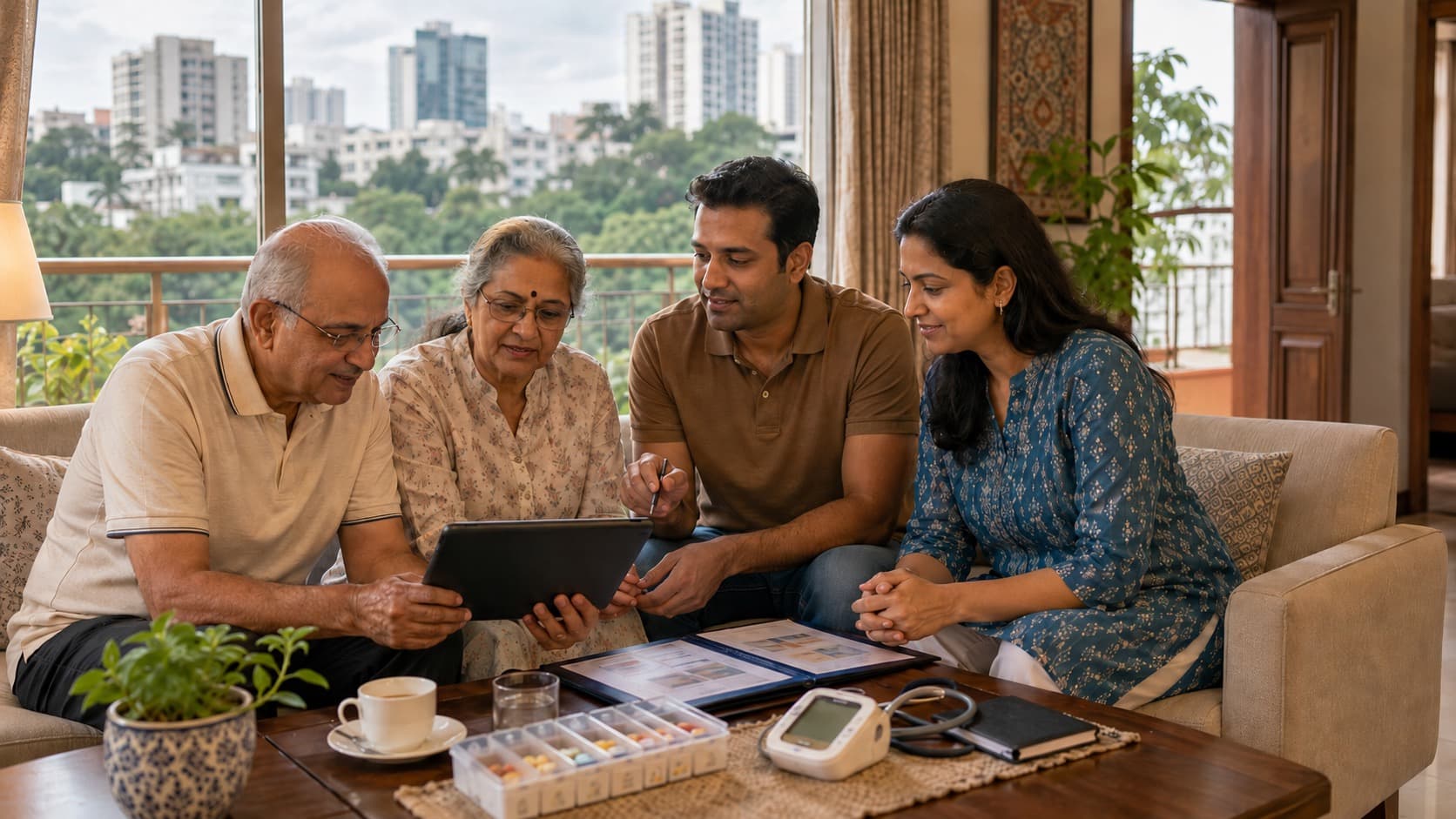
An elder care subscription plan is worth it if your parents need regular check-ins, coordination with their doctors, and someone local who can act in an emergency, and you cannot be physically present to manage these things yourself. For families paying ad-hoc for hospital visits, diagnostic tests, and emergency coordination, a subscription often costs less than piecemeal arrangements while giving you continuity through a dedicated Care Manager who knows your parents' medical history, preferences, and local doctors.
However, not every family needs the most intensive level of support. A healthy, independent parent with a strong local support network may only need occasional assistance. The value depends entirely on your parents' health status, your involvement level, and how much coordination you currently handle from a distance.
What You Actually Get in an Elder Care Subscription
Most families researching elder care plans in Bangalore discover that a subscription bundles services they are already paying for separately. Understanding this breakdown helps you evaluate whether the monthly fee represents genuine savings or unnecessary overlap.
Core Components
A senior care subscription with Kareverse includes:
- A dedicated Care Manager who coordinates your parents' care and stays involved month to month
- Regular home visits to check physical health, home safety, and emotional wellbeing
- Family updates after each home visit, with plain-language notes you can forward to siblings
- A weekly wellbeing check-in so issues surface early rather than at a crisis
- Doctor coordination so a doctor reviews your parents' records and speaks with them regularly
- 24/7 emergency support, including arranging an ambulance, help with admission, and staying with your parent in the first hours
Normal Care, and Then More When It Is Needed
Kareverse uses one core plan, Normal Care, for every family. On top of it, there are special-care programmes for specific conditions such as dementia, Parkinson's, stroke recovery, cancer treatment support, and dialysis support. You start with Normal Care and add a programme only if your parent's condition calls for it, so you are never paying for intensive support you do not use.
The Kareverse Care Plan: What It Costs
Every family starts with the same core plan. Care Plan subscribers also get 20% off Genie bookings and partner services when they add extra help.
Normal Care
Best for: parents who need a steady point of contact, regular eyes on the ground, and reliable emergency cover.
Price:
- ₹5,999 a month, paid monthly
- ₹4,999 a month, paid quarterly (₹14,997 every three months)
- ₹4,499 a month, paid annually (₹53,988 a year)
Includes:
- A dedicated Care Manager to coordinate your parents' care
- One 60-minute home visit each month to see how your parents are doing
- One wellbeing check-in each week
- A home-safety check in the first month, covering risks such as poor lighting and obstacles
- One doctor consultation every three months, with the doctor reviewing your parents' records
- 24/7 emergency support, including ambulance, admission help, and staying with your parent in the initial hours
- An update for your family after each home visit
Honest assessment: this is the right starting point for most families. It works whether your parents are largely self-sufficient and you want a local contact who knows them, or they have stable health that needs consistent oversight rather than intensive daily care.
Special-Care Programmes
When a parent has a specific condition, a programme is added on top of Normal Care so the extra visits and specialists are built in.
- Dementia and Alzheimer's Care: ₹12,000 a month on top of Normal Care. Adds a psychologist's initial review and activity plan, three 90-minute home visits a week by a dementia-trained care assistant, a monthly plan review, and guidance for the family.
- Parkinson's Care: ₹8,000 a month on top of Normal Care. Adds eight 60-minute physiotherapy sessions a month with a therapist experienced in Parkinson's, an exercise plan, and guidance for the people helping.
- Stroke Recovery, Cancer Treatment Support, and Dialysis Support: priced after a short discussion or a home assessment, because the right frequency of therapy or accompaniment depends entirely on your parent's stage and schedule.
Honest assessment: the fixed programmes suit families managing a diagnosed, stable condition at home. The quote-based programmes suit recovery or treatment periods where the schedule is set by the hospital, and you want a Care Manager holding it all together.
Calculating the Real Monthly Elder Care Cost
To decide whether a subscription saves money, compare it to your current ad-hoc spending. Many NRI families underestimate what they already pay because costs are spread across many separate transactions.
Typical Ad-Hoc Costs in Bangalore
| Service | Typical Cost | Frequency |
|---|---|---|
| Home nursing visit | ₹800 per hour | 4–8 times monthly |
| Physiotherapy session | ₹900 per session | 4–8 times monthly |
| Doctor coordination and appointments | ₹500–1,000 | 1–2 times monthly |
| Diagnostic coordination | Coordination plus lab costs | 1–2 times monthly |
| Emergency coordination | ₹2,000–5,000 | As needed |
Once you add a Care Manager to organise all of this, keep a central health record, and act in an emergency, a single monthly plan is usually simpler and cheaper than paying for each piece and coordinating it yourself from another time zone.
Hidden Costs of Not Having a Subscription
Beyond direct expenses, consider emergency flight costs when issues escalate, repeated diagnostic tests because no one maintains a central health record, hospital readmissions from missed medicines, and your own time spent coordinating from abroad across time zones.
How to Choose What Your Parents Need
Deciding on elder care in Bangalore comes down to an honest look at your parents' situation and your own capacity to manage their care remotely.
Questions to Ask Yourself
-
How often do I currently call or video chat with my parents? If daily, you may notice issues quickly. If weekly or less, you need more external monitoring.
-
Do my parents have chronic conditions requiring regular monitoring? Diabetes, hypertension, heart conditions, and arthritis all benefit from consistent oversight.
-
How many medicines do they take daily? Three or more increases the risk of errors and interactions.
-
Have they had falls, hospitalisations, or emergencies in the past year? Recurring incidents signal a need for more frequent visits.
-
Do they have reliable local support? Siblings, relatives, or trusted neighbours reduce dependency on professional services.
-
How quickly can I reach Bangalore in an emergency? If travel takes 12 or more hours, you need stronger local coordination.
A Simple Selection Framework
| Your Situation | What Fits |
|---|---|
| Parents healthy, you visit regularly | A one-time Kare@home Assessment, or Genie tasks as needed |
| Parents healthy, you live abroad | Normal Care |
| One or more chronic conditions, several medicines | Normal Care |
| A diagnosed condition such as dementia or Parkinson's | Normal Care plus the matching programme |
| Recovery or active treatment (stroke, cancer, dialysis) | Normal Care plus a quote-based programme |
When a Subscription Plan Is NOT Worth It
Honest guidance means acknowledging when a subscription adds cost without value.
Skip the Subscription If:
- Your parents have strong local family support who visit regularly and manage healthcare
- You live in Bangalore and see your parents weekly and can coordinate yourself
- Your parents are in an assisted living facility where most services are already included
- Your parents refuse external involvement, since a subscription only works with their cooperation
- Finances are tight and needs are minimal, where ad-hoc help for genuine emergencies may be more practical
Consider One-Off Help Instead:
Kareverse offers standalone services without a subscription:
- Kare@home Assessment Visit: ₹999 (one-time, in-home evaluation with a Family Report)
- Genie by Kareverse for one-off tasks such as a hospital appointment, everyday help at home, or getting something sorted
- Home nursing from ₹800 an hour, physiotherapy from ₹900 a session, and a caretaker from ₹1,100 a day
These work well for families who need occasional help rather than ongoing oversight.
Making the Decision
The question "is an elder care subscription plan worth it?" has no universal answer. It depends on your parents' health, your distance, your available time, and your risk tolerance.
Many families begin with a one-time Kare@home Assessment, then move to Normal Care once they see what ongoing support would cost them in time and worry. A subscription is worth it when it prevents one emergency hospitalisation, catches one missed medicine, or simply lets you sleep better knowing someone qualified checked on your parents this week.
Frequently Asked Questions
How much does the Kareverse Care Plan cost?
The Care Plan (Normal Care) is ₹5,999 a month paid monthly, ₹4,999 a month paid quarterly, or ₹4,499 a month paid annually. It includes a dedicated Care Manager, a monthly home visit, a weekly wellbeing check-in, a first-month home-safety check, a doctor consultation every three months, and 24/7 emergency support. Special-care programmes for conditions such as dementia and Parkinson's are added on top when needed.
Can I change my billing term or level of care?
Yes. You can move between monthly, quarterly, and annual billing, and you can add or remove a special-care programme as your parent's condition changes. Your Care Manager can recommend adjustments based on what they observe.
What happens if my parents need services beyond the plan?
Extra help such as nursing, a caretaker, physiotherapy, or Genie tasks can be added as needed. Care Plan subscribers get 20% off Genie bookings and partner services. Your Care Manager coordinates these and confirms the price with you before anything is booked.
How is the Family Report delivered and what does it include?
After each home visit you receive an update, usually as a PDF on WhatsApp. It covers physical health, mood and social engagement, home safety, medicine compliance, upcoming appointments, and specific recommendations. Photos are included with your parents' consent.
Does the Care Plan include a caretaker or nurse living in?
Normal Care coordinates your parents' care but does not include a full-time caretaker or live-in nurse. Those are added when needed at subscriber rates, or built into a special-care programme where the condition calls for regular hands-on support.
Kareverse serves families across Whitefield, Marathahalli, Sarjapur, HSR Layout, Koramangala, JP Nagar, Jayanagar, Malleswaram, and Yeshwantpur. To discuss what fits your parents' needs, WhatsApp +91 90355 54540 or visit kareverse.com to schedule a Kare@home Assessment Visit.