

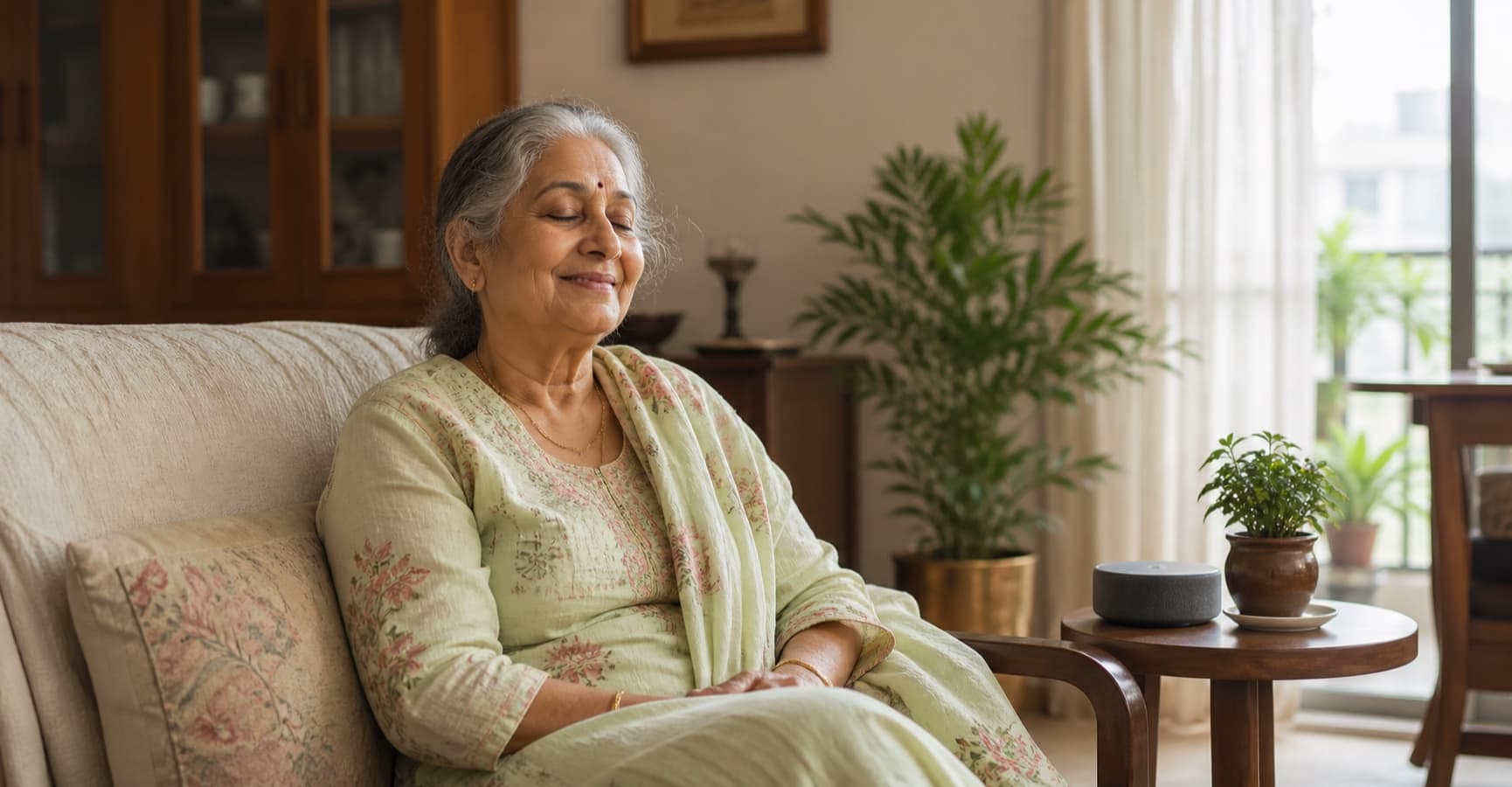
You are on a video call with your mother, and the conversation has run dry. She has told you she is fine, the weather is the same, she has eaten. There is a pause. Then, almost on a whim, you play an old Lata Mangeshkar song you both know, and something changes. Her face softens. She hums along. She tells you a story about the first time she heard it, at a wedding, decades ago. For ten minutes, the distance between Bangalore and wherever you are simply disappears.
Music does that. It reaches parts of an aging mind that ordinary conversation cannot, and it asks almost nothing of a parent who is tired, low, or slipping a little. For families, it is one of the gentlest and most underused tools in elder care.
Why old songs reach where other things cannot
There is a reason your father can forget what he ate for lunch but remember every word of a film song from 1971. The parts of the brain that hold deeply familiar music are among the most stubborn to fade. A song learned in youth, played over and over across a lifetime, is woven so deeply that it often survives even when newer memories grow unreliable.
This is why music can reach a parent in the early stages of memory loss when ordinary conversation frustrates them. It does not ask them to remember anything or answer a question. It simply arrives, familiar and whole, and carries a feeling and a time with it. A parent who cannot recall your last visit may still light up at the first bars of a song from their wedding.
And it is not only about memory. Familiar music calms the nervous system. It slows a racing mind, lifts a low mood, and gives a lonely afternoon some company. For that, a parent does not need to remember a single lyric. The feeling does the work.
The everyday ways music helps
You do not need a plan or a therapist to use music well. A few simple habits are enough.
To start the day gently. Playing a favourite bhajan or a bit of morning raga while a parent has their tea sets a calm, familiar tone. It becomes a signal that the day has begun, which is especially helpful for a parent whose routine has grown shapeless.
To ease difficult evenings. Many older parents grow restless, anxious, or agitated as the light fades, a pattern families of those with memory loss know well. Soft, familiar music in the late afternoon can take the edge off that hour far more kindly than television or a bright screen.
To make movement fun. A parent who resists exercise will often sway, tap a foot, or walk a few extra steps when the right song is playing. Music turns a dull stretch of physiotherapy or a walk around the room into something closer to enjoyment.
To fill a lonely stretch. For a parent who lives alone, an afternoon can feel very long and very quiet. A radio programme of old songs, or a familiar playlist, is undemanding company that asks nothing back.
To bridge a video call. When conversation stalls, as it does, a shared song gives you and your parent something to do together across the distance. Playing it at the same time, humming along, is a small act of togetherness that words sometimes cannot manage.
How to find the songs that matter
The music that works is not the music you love. It is the music your parent loved when they were young, roughly between their teens and their thirties, the years when songs stamp themselves deepest. For most parents in Bangalore that might mean old Hindi film music, Kannada classics, devotional songs and bhajans, Carnatic pieces, or the ghazals and film songs of their courting years.
The way to find them is simply to ask, and to watch. Ask what played at their wedding, what their favourite singer was, what film they saw again and again. Then watch their face when you play something. The song that makes them sit up, hum, or start telling a story is the one to keep. Build a small collection of those, rather than a huge library they will never use. A dozen well-loved songs, easy to play, beats a thousand they feel nothing for.
Keep the practical side simple too. An older parent should not have to fight with a complicated app. A preset playlist that plays with one tap, a simple speaker they can switch on, or an old-fashioned radio tuned to a station that plays their era of music will get used far more than something clever they cannot operate.
A gentle word of care
Music is powerful, and that cuts both ways. Now and then a song will carry a sad memory, and a parent may grow tearful. That is not a failure. Sometimes a good, gentle cry over a beloved song is its own kind of release. But stay near, notice how a particular song lands, and quietly set aside anything that reliably brings distress rather than comfort.
For a parent who seems persistently low, withdrawn, or without interest in the things they once loved, music is a lovely companion but not a treatment. Low mood that lingers deserves proper attention, not just a cheerful playlist. If that sounds familiar, it is worth understanding the difference between an off week and something that needs care, which our guide to cognitive decline in elderly parents can help you think through, and a doctor can assess properly.
Music, company, and staying connected
The deepest gift of music is not really the songs. It is connection. A parent singing along with a caretaker, humming with a neighbour, or sharing a favourite film tune with you on a call is, for those minutes, not alone. That thread of connection is one of the strongest protectors of an aging mind and heart, as our piece on friendship and longevity explores.
This is part of the spirit of Active Age at Kareverse: keeping an older parent engaged, expressive, and connected, not just fed and safe. A Care Manager or caretaker who learns which songs your parent loves can weave them into the day, into a walk, into a quiet afternoon, so the hours have some warmth in them. It costs nothing and means a great deal.
Frequently asked questions
My parent has memory loss. Will music really help?
Often, yes. Deeply familiar music from a parent's youth tends to survive even when newer memories fade, and it can reach and calm a parent when conversation cannot. It will not restore memory, but it can bring comfort, ease agitation, and open a moment of connection. Watch how each song lands and keep the ones that bring calm.
What kind of music works best?
The songs your parent loved in their teens, twenties, and thirties, whatever those were: old Hindi or Kannada film songs, bhajans, ghazals, Carnatic pieces. What you enjoy matters less than what carries meaning for them. Ask about their wedding, their favourite singer, and the films they loved.
How do I set this up from abroad?
Build a small playlist of their favourite songs and put it on a simple device or speaker they can operate with one tap, or ask a caretaker to play it. You can also play a shared song during video calls to give you both something to enjoy together across the distance.
Can music help with restlessness in the evenings?
Often it can. Many older parents grow more anxious or restless as the light fades. Soft, familiar music in the late afternoon and early evening can settle that hour more gently than a loud television or a bright screen. If restless, poor evenings are also disrupting sleep, our guide to sleep problems has more to try.
Is a caretaker able to do this?
Yes, and it is one of the nicest parts of good companionship. A caretaker can learn your parent's favourite songs, play them during the day, sing along, and gently use music to make walks, meals, and quiet afternoons warmer. A caretaker's role here is company and comfort, alongside the everyday support they provide.
A small thing worth doing
You do not need a device, an app, or a budget. You need to know a handful of songs your parent loves, and a simple way to play them. Start with one. Play it on your next call and watch what happens.
If you would like a fuller picture of how your parent is doing, and practical ways to keep their days warmer and more connected, a Kare@home Assessment Visit is a good starting point. For ₹999, a Care Manager visits at home and reviews health, mood, routine, and wellbeing, then sends the family a Family Report within 48 hours. From there, whether it is regular companionship, an Active Age routine, or a caretaker for daily support, the plan is built around what your parent actually needs.