

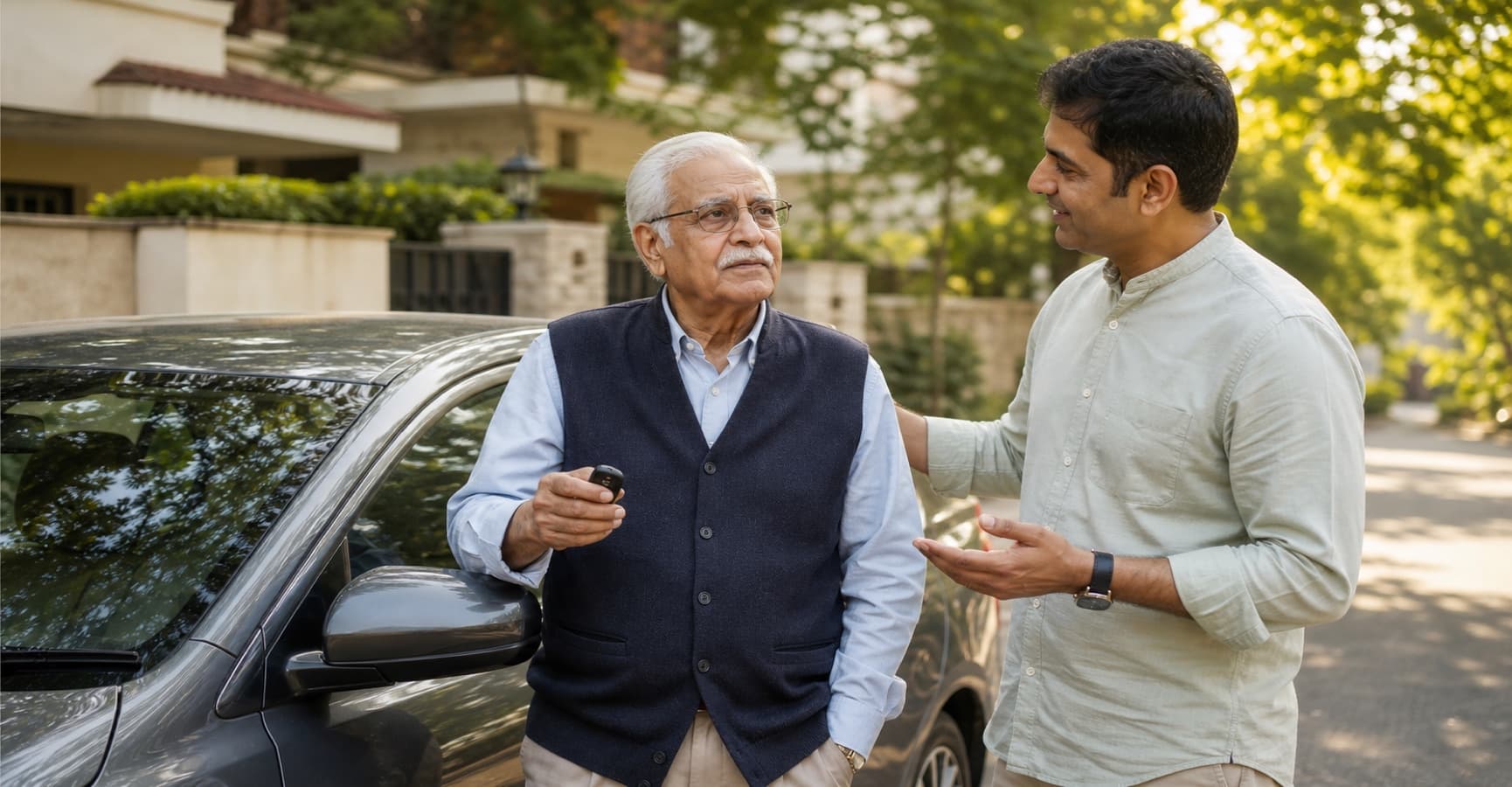
Of all the difficult conversations that come with aging parents, few are as loaded as the one about driving. A car is not just transport. For a parent who has driven for fifty years, it is independence, dignity, and identity, the freedom to go where they want, when they want, without asking anyone. Suggesting they hand over the keys can feel, to them, like being told their useful life is over.
And yet, for many families, there comes a point where continuing to drive is genuinely unsafe, for the parent and for everyone else on the road. Bangalore traffic is fast, dense, and unforgiving of slow reactions. Getting the timing of this decision right, not too early, not dangerously late, and getting the conversation right, is one of the most important things you can do.
This is a guide to reading the signs honestly, raising it with respect, and, just as importantly, making sure that giving up the wheel does not mean giving up a life.
Why driving gets harder with age
Ageing affects the very abilities that safe driving depends on, and it does so gradually, so the person behind the wheel is often the last to notice.
Reaction times slow, so the split second needed to brake for a child darting out or a bike cutting across takes longer. Eyesight changes, making glare, night driving, and judging distances harder, which is why our guide to vision and cataract care matters here too. Neck and joint stiffness make it harder to turn and check blind spots. Hearing loss can mean missing a horn or a siren. And any early change in memory or thinking can affect judgement, navigation, and the ability to handle the unexpected.
None of this means every older person must stop driving. Many drive safely well into later life. It means the decision has to be based on how your parent is actually doing now, not on age alone, and not on how they drove ten years ago.
The warning signs it may be time
Watch for these, ideally by sitting in the car as a passenger a few times rather than relying on what your parent tells you. A pattern of several is more telling than a single event.
- New dents and scrapes on the car, the gate, or the garage wall, often unexplained or brushed off.
- Getting lost on familiar routes, or moments of confusion at junctions they have known for years.
- Slow or delayed reactions, braking late, missing signals, not noticing a pedestrian or two-wheeler until the last moment.
- Drifting between lanes, straddling markings, or difficulty staying centred.
- Trouble with speed, either far too slow and hesitant, or not judging when to stop.
- Close calls and near-misses, other drivers honking, sudden hard braking, incidents your parent laughs off but that keep happening.
- Getting flustered or overwhelmed in traffic, at roundabouts, or when merging, which never used to bother them.
- Tickets or warnings they did not mention.
If you would feel uneasy putting a grandchild in the back seat, that unease is your answer.
How to have the conversation without a fight
This is where most families go wrong, not on the facts, but on the approach. Handled badly, it becomes a battle that damages trust and makes your parent dig in. Handled well, it can be a decision they come to feel is partly their own.
Start early and gently. Do not wait for a crisis or an accident. Raise it as a caring, ongoing conversation, not a one-time verdict delivered from above.
Lead with concern, not commands. "I love you and I would never forgive myself if something happened to you" lands very differently from "You are too old to drive." One is about protecting them; the other is about taking something away.
Listen to what the car means to them. Underneath the resistance is usually a real fear: of becoming dependent, of being stuck at home, of losing status among friends. Name that fear and address it directly. The conversation is really about independence, not driving.
Bring in an ally. Parents often accept from a doctor or a respected outsider what they resist from their own children. A doctor can assess fitness to drive as a medical matter, which takes the decision out of the emotional family arena.
Focus on a solution, not just a loss. The single most powerful move is to arrive with a plan for how they will still get everywhere they want to go. If giving up the keys does not mean giving up their life, the whole conversation changes. That is the next section.
Our guide to talking to parents about accepting help covers the wider art of these conversations, and much of it applies here.
Keeping your parent mobile after they stop driving
The reason parents cling to the wheel is the fear of being trapped. Take that fear away and resistance often melts. The goal is not to end their outings but to change how they happen, so they lose the driving, not the destinations.
For everyday needs, a mix works well: family for some trips, trusted local drivers or app-based cabs for others, and help arranging it so your parent is never stranded. The temple visit, the doctor's appointment, meeting friends, the weekend outing, all of these can continue.
For families who live far away, the hard part is that these trips happen while you are asleep in another time zone. This is where Genie by Kareverse helps. The idea is simple: the things you would do for your parents, if you were here. A Genie can take your parent to and from an appointment, an outing, or a family function and stay with them through it (Go With Them, about five hours), so a parent who has stopped driving still gets to the places that matter, with company, not alone in a stranger's cab. A Genie never touches money, never asks for a PIN, and never transacts on your parent's behalf. It is presence and legwork, booked from wherever you are.
Framed this way, giving up driving becomes an upgrade in some respects: someone else deals with the traffic and the parking, and your parent arrives relaxed. That is a much easier thing for a proud parent to accept than simply losing the car.
Frequently asked questions
How do I know if my parent is genuinely unsafe or just older?
Age alone does not decide it; behaviour does. Sit in the car as a passenger a few times and watch for late reactions, drifting, getting lost, near-misses, and new dents. A pattern of these is the signal. A doctor can also assess fitness to drive as a medical matter, which helps take the emotion out of it.
My parent refuses to even discuss it. What do I do?
Do not turn it into a single confrontation. Raise it gently and repeatedly over time, lead with love and worry rather than commands, and bring in a doctor as a neutral voice. Above all, arrive with a concrete plan for how they will still get everywhere, because most resistance is really fear of being stuck at home.
Should the doctor be involved?
Often, yes. Many parents accept a driving decision from a doctor more readily than from their children, and a doctor can assess vision, reactions, and thinking objectively. Our guide to talking to parents about accepting help explains how to bring in outside voices well.
We live abroad. How can we manage this from far away?
You can start the conversation on calls and visits, and lean on a doctor locally. For the practical side, ongoing mobility after they stop driving, Genie by Kareverse can take your parent to appointments and outings and stay with them, so they are never stranded and you are never guessing how they will get there.
Does vision have anything to do with it?
A great deal. Glare, poor night vision, and trouble judging distance, often from cataract, make driving dangerous and are common in older adults. It is worth reading our guide to vision and cataract care, as treating the eyes sometimes changes the picture.
A simple next step
The driving conversation is really a conversation about independence, and the kindest way to have it is to protect the independence while removing the risk. When your parent can see that life will still take them everywhere they love to go, handing over the keys stops feeling like a loss.
If you are not sure how safe your parent really is, or how they are coping day to day, a Kare@home Assessment Visit is a good place to start. For ₹999, a Care Manager visits at home and reviews health, vision, mobility, and daily routine, then sends the family a Family Report within 48 hours. From there, Genie by Kareverse can keep your parent moving to the places that matter, and if daily support would help, a caretaker can be placed.