

The tickets are booked. Your parents are flying out to spend the winter with you, or you are flying them home for Diwali, or one of them is making the trip alone for the first time in years. On the phone they sound excited. "Don't worry, we have done this before."
They have. But the last time may have been ten years and two knee problems ago. Airports have got bigger, walks to the gate have got longer, and a 17-hour journey asks a lot of a 75-year-old body. Flying with elderly parents goes well when a few things are arranged in advance, and badly when everyone assumes it will sort itself out at the airport.
This guide covers what to book, what to pack, how to handle the flight itself, and the part most families forget: the first two days after landing.
Flying with elderly parents starts at the booking stage
Most of what makes the day easy has to be requested before the day.
Ask for wheelchair or special assistance when you book. Even a parent who walks well can find the distance from check-in to a far gate exhausting, especially with queues, stairs, and a bag to carry. Bengaluru's Kempegowda International Airport asks passengers who need wheelchair assistance to request it from their airline at the time of booking, or at least 48 hours before travel. Most airlines let you add it online or through customer care. Ask for it on every leg, including connections and the arrival airport.
Some parents resist the wheelchair because it feels like admitting frailty. A gentle way to put it: "It is not because you can't walk. It is because the airport is two kilometres long and we want you fresh when you land." Many accept it once they realise it also means help through security and boarding.
Choose the seat deliberately. An aisle seat near the toilet makes it easier to get up, stretch, and reach the washroom without climbing over strangers. Avoid tight connections; a two to three hour layover gives room for a slow transfer.
Request the right meal. Many airlines offer diabetic, low-salt or vegetarian meals if requested in advance. It is worth doing for a parent with diabetes or blood pressure concerns.
Check fitness to fly with their doctor. If your parent has had recent surgery, a recent hospital stay, heart or lung problems, uses oxygen, or has trouble with breathing on stairs, ask their doctor before booking whether flying is safe and whether any precautions are needed. Airlines may ask for a medical form for some conditions, so it is better to know early. Our guide on post-hospital care for elderly parents covers the recovery period when travel is often best postponed.
Look at the travel insurance closely. For international trips, check that the policy covers your parent's age and their existing conditions. Some cheaper policies exclude exactly the problems an older traveller is most likely to have.
At the airport in Bangalore
Bengaluru airport has dedicated arrangements for passengers with reduced mobility, including dedicated drop-off and entry points, help through security, and accessible washrooms. Details differ by terminal, so check the airport's website for your terminal before the day.
A few habits make the departure calmer:
- Arrive early, but not too early. Enough time that nobody rushes, not so much that your parent sits for four hours on hard seats.
- Go straight to the airline counter and confirm the assistance is in place. The airline's staff take over from there.
- Keep passports, boarding passes and the medicine list together in one easy-to-reach pouch, not scattered across bags.
- Stay in touch. If your parent is travelling alone, make sure their phone is charged, roaming works, and they know who will meet them on arrival.
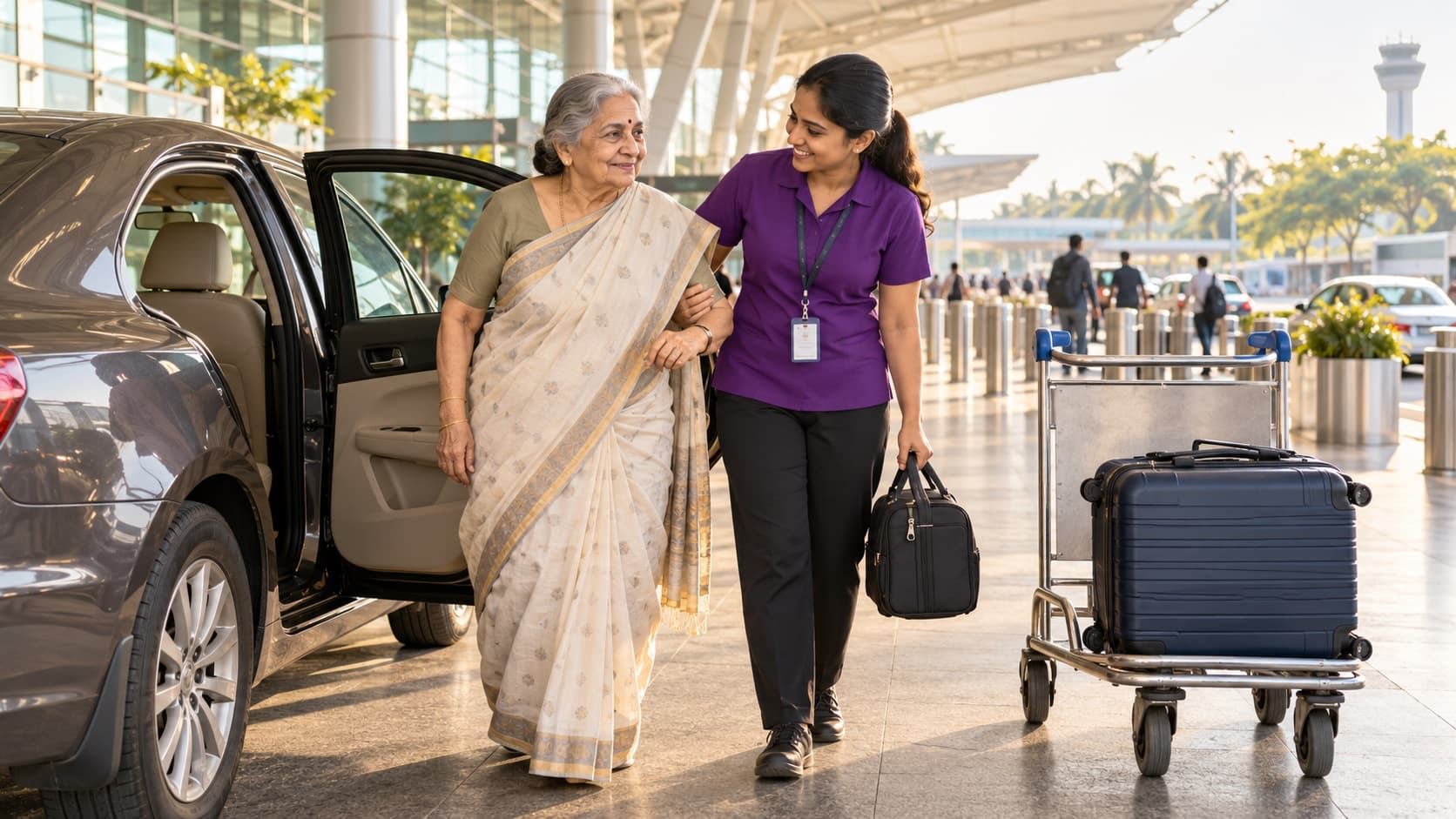
If no family member can take them to the airport, someone still needs to. That is one of the gaps Genie by Kareverse fills: a Genie accompanies your parent from home to the airport, helps with luggage and finding the way in the areas open to them, and sees them off, or receives them on the way back and brings them home. Inside the restricted areas, the airline's assistance team takes over.
The cabin bag: what to keep within reach
The checked bag can go missing. The cabin bag cannot. Everything your parent would struggle without for two days belongs in it.

Medicines, Plus Extra
Prescription and Medicine List

Water and a Light Snack

Glasses and Hearing Aids

A Warm Layer and Socks

A Contact Card
Some medicines are restricted or need special paperwork in certain countries. If your parent takes strong painkillers, sleeping tablets or other controlled medicines, check the destination country's rules before travel. Our guide on medication management for elderly parents has a simple way to keep the medicine list up to date.
On a long flight
A long-haul flight is mostly sitting still in dry air for many hours. That brings three things to watch.
Moving the legs. Sitting for long periods raises the risk of blood clots in the legs, and that risk is higher in older travellers and those with certain health conditions. Ankle circles, pressing the feet up and down, and a short walk down the aisle when it is safe to do so all help. If your parent has had a clot before, recent surgery, or heart problems, ask their doctor whether compression stockings or other precautions make sense.
Drinking enough. Older adults feel thirst less, and a parent who avoids water to avoid the toilet can arrive dehydrated, dizzy and confused. Our guide on dehydration in seniors explains why it matters so much at this age.
Getting up safely. Stand slowly, hold the seat backs, and wait a moment before walking, because standing up fast after hours of sitting can make an older person light-headed. The aisle at night is also dark and narrow, and a stumble on a plane is a real risk.
Medicine timings across time zones. Crossing several time zones shifts when "morning" and "night" doses fall. For most tablets this is simple, but for insulin, blood thinners and some heart medicines it needs a plan. Ask the doctor before the trip how to adjust the timings, and write the plan down.
When your parent arrives somewhere new
A change of place affects older people more than we expect. Jet lag, a different bed, a strange bathroom at night, and a full house can leave a parent tired, unsteady, or briefly confused for the first few days. For a parent with existing memory changes, a new environment can make that confusion more noticeable. Our guide on memory changes in aging parents explains what to look out for.
Small things help:
- A night light between the bed and the bathroom, and nothing on the floor in that path
- Daylight and a short walk on the first mornings, which helps the body clock settle
- The same medicine times as at home, adjusted as the doctor advised
- A quiet first day, before the relatives and the outings begin
Our guides on fall prevention at home and sleep problems in elderly parents cover both in more detail.
The first 48 hours back in Bangalore
This is the part most families plan least. The parents fly back after weeks or months away, tired and jet-lagged, into a house that has been shut. The fridge is empty, the water may have been off, the medicines might be running low, and the house help may not have restarted yet. The family abroad goes back to work, assuming everything is fine because the flight landed.
A little planning closes that gap:
- Someone meets them at the airport and goes home with them
- The house is opened and aired before they arrive, with water, milk and basic groceries in
- Medicines are checked and restocked, ideally before the trip, not after it
- Someone checks in on them in person on the first and second day, not just by phone
If there is no family member nearby, Genie by Kareverse can help: a Genie can receive your parent at the airport and bring them home, be at the house for a check-in visit in the days after, or collect medicines. A Genie never touches money, never asks for a PIN and never transacts on your parent's behalf. It is simply the presence you would provide yourself if you were in the city.
Frequently asked questions
How do I book wheelchair assistance for my parent at Bangalore airport?
Request it from the airline, not the airport, at the time of booking or at least 48 hours before the flight. Most airlines let you add it online or through customer care. Ask for it on every leg of the journey, including the arrival airport and any connection.
Can my elderly parent fly alone?
Many older adults fly alone safely with the right support: airline assistance booked, medicines in the cabin bag, a charged phone, and someone confirmed to meet them at each end. If your parent has memory problems, gets easily confused, or has a serious health condition, discuss it with their doctor first and consider whether someone should travel with them.
What medicines should my parent carry on the flight?
All regular medicines, in the cabin bag, in their original packaging, with a few extra days' supply and a copy of the prescription. Check the destination country's rules if any medicines are controlled, and ask the doctor how to adjust timings across time zones. Our guide on medication management covers keeping a clear medicine list.
Is flying safe for elderly parents with heart or breathing problems?
Often yes, with the right precautions, but it should be checked with their doctor before booking. Recent surgery, a recent heart event, breathing difficulty or oxygen use may need specific advice or airline paperwork. Our guide on breathlessness in elderly parents explains which symptoms need attention first.
Who can take my parent to the airport if I am abroad?
A relative or trusted neighbour, if available. If not, Genie by Kareverse offers airport pickup and drop: a Genie travels with your parent between home and the airport, helps with luggage and finding the way, and updates you. Our guide on how to care for parents from abroad covers building that local support more widely.
A simple next step
A good trip comes down to a little planning before your parent leaves, and someone they can count on at both ends of the journey.
Genie by Kareverse can take care of the airport runs and the first days back: getting your parent to the airport, receiving them when they land, and checking in on them at home once they are settled. If your parent needs steady daily help at home, a caretaker can be placed from ₹1,100 a day.