

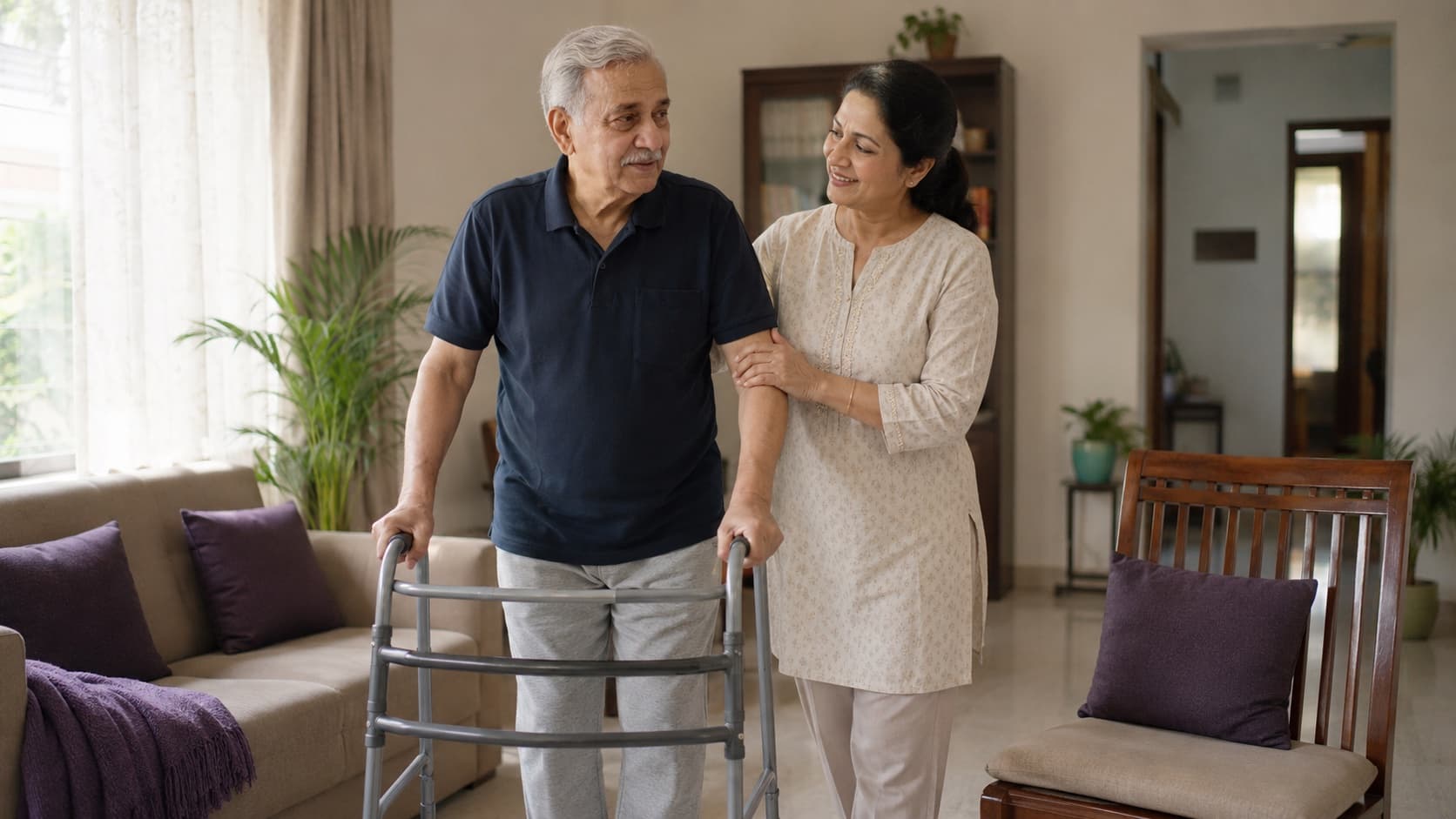
Your parent survived the stroke. The hospital stay, terrifying and seemingly endless, is finally over. Now they are home, and the real work begins.
Stroke recovery is rarely a straight line. Some days your parent will surprise you by standing on their own. Other days they will seem to slip backwards. That unpredictability is what wears families down. What helps is a clear framework: not false hope, not despair, but a practical picture of what recovery at home actually looks like, and where to focus your energy.
What a stroke actually does
A stroke is an injury to the brain, caused either by a clot or by bleeding. It damages brain cells, and every symptom your parent has, whether weakness on one side, difficulty speaking, memory gaps, or sudden changes in mood, traces back to which part of the brain was affected and how badly.
This matters because recovery depends on the brain's ability to slowly rebuild connections around the damaged area. That rewiring is real, but it is gradual. It needs repetition, effort, and time, usually months, sometimes longer.
The discharge summary will note which part of the brain was affected. It is worth asking the doctor directly: was the side that controls language involved, what abilities are likely to be affected, and what should we realistically expect? Clear answers help you plan. Vague reassurance does not.
Physiotherapy: the foundation of recovery
Regaining movement after a stroke depends on one thing above all: consistent, guided exercise. Not the occasional walk around the living room, but structured, step-by-step rehabilitation.
The first few months are the most important window. This is when the brain responds best to therapy, so the effort you put in early tends to shape how much your parent recovers.
For most families in Bangalore, physiotherapy at home is the practical choice. Getting a parent with one-sided weakness into a car for clinic visits twice a week exhausts everyone. A physiotherapist coming to your home in Whitefield, Koramangala, or JP Nagar removes that barrier, and our guide on what home physiotherapy involves and costs explains how it works.
Good home physiotherapy usually includes:
- An honest assessment of your parent's current movement, with clear goals
- Progressive exercises, starting with gentle assisted movement and building towards strength work
- Walking practice, with a stick or walker where needed
- Balance training, because falls are a real risk after a stroke
- Teaching the family the daily exercises to continue between visits
Frequency matters more than intensity. Short daily sessions do more than one long session a week. If you can only arrange two or three physiotherapy visits a week, make sure the physiotherapist teaches you or the caretaker the exercises to repeat every day. Balance and safe movement are central here, so it is worth reading our guide to fall prevention at home as well.
Speech and language
If the stroke affected the side of the brain that controls language, your parent may struggle to speak, understand, read, or write. This can take two broad forms. In one, they know what they want to say but cannot find the words, which is deeply frustrating for them. In the other, they speak easily but do not fully follow what is said to them, and may not realise their own words are not making sense.
Speech therapy can be arranged through hospitals or home care services. But families often miss the most powerful tool: you. Talking to your parent normally, rather than in simplified baby talk, makes their brain work to process language. Reading aloud to them, naming everyday objects together, and gently having them repeat words all help, and these small daily moments add up.
Be patient with the frustration. A parent who spoke beautifully all their life and now struggles to say "water" will have moments of anger, grief, or withdrawal. It is normal. Try not to take it personally.
The emotional side, which families often miss
Low mood after a stroke is common, and Indian families routinely miss it, putting withdrawal or irritability down to the stroke itself or to old age. It deserves attention, because it is treatable and it directly affects recovery.
Watch for:
- Losing interest in things they used to enjoy
- Sadness or emptiness that lasts more than two weeks
- Sleeping far too much or too little
- Saying things like "you would be better off without me"
- Refusing to take part in their exercises
What helps is a sense of purpose and connection. A steady daily rhythm gives shape to the day, so a predictable daily routine is genuinely therapeutic. Gently bringing back small social and religious moments helps too, even if it is only sitting in the temple courtyard for twenty minutes. Involve your parent in ordinary decisions, however small, such as whether to make sambar or rasam tonight. And if low mood persists, do not dismiss counselling as unnecessary. A doctor consultation is a sensible first step to get the right support.
Making the home safe
Before your parent comes home, walk through the house and look for hazards. Someone with one-sided weakness or shaky balance faces risks in almost every room.
The changes that matter most:
- Remove loose rugs and mats, which are easy to trip on
- Fit grab bars in the bathroom, beside the toilet and in the bathing area
- Raise the toilet seat, because sitting down and standing up is hard with weak legs
- Keep pathways clear and well lit, especially at night
- Move the bed to the ground floor if you can, as stairs are dangerous early on
- Use non-slip mats in the bathroom and kitchen
- Set up a recovery corner: a bed or chair with the phone, water, medicines, and a bell all within reach
Our guides to bathroom safety and bedroom safety walk through these changes in detail. In a compact Bangalore apartment some of this is harder, but simple solutions work well: a commode chair near the bed, portable grab bars, and rearranging furniture to widen the walking paths.
What to realistically expect, month by month
Every stroke is different, but recovery tends to follow a broad pattern.
The first few weeks are usually the weakest. The focus is on the basics: sitting up, swallowing safely, and managing the toilet. This is when hands-on support at home matters most, especially if the other parent is also elderly and the caregiving falls on one ageing spouse. A trained caretaker for daily help, or home nursing for clinical care such as feeding support or wound care, can take enormous pressure off the family.
Months two and three often bring the fastest improvement: walking with help, managing more self-care, and speech starting to return if it was affected. Therapy should be at its most consistent during this stretch.
Months four to six usually see gains slow but continue. Many people walk again on their own, often with a stick or walker. Fine hand movements recover more slowly, and some difficulty may remain.
Beyond six months, progress becomes gradual and steadier effort is needed. Keeping up the exercises matters, because it protects the ground already gained.
Throughout, rebuilding strength needs good nutrition, so our guide to adapting Indian meals for better health is a useful companion.
Know the warning signs of another stroke
Someone who has had one stroke is at higher risk of another, so knowing the warning signs matters. The simplest way to remember them is the word FAST:
- Face: one side of the face droops or feels numb
- Arm: one arm is weak, or drifts down when both are raised
- Speech: speech is slurred, or your parent cannot speak or understand
- Time: if you see any of these, act immediately
Other sudden signs include a severe headache, loss of vision in one or both eyes, or sudden difficulty walking or dizziness. Do not wait, do not call a relative for advice, and do not drive to the hospital yourself. Call 108 for an ambulance. Every minute of delay costs more brain cells.
Find out in advance which large hospital near you runs a round-the-clock stroke unit. Many of the major private hospitals in Bangalore do, and knowing the closest one before an emergency saves precious time. Keep that number, and 108, somewhere everyone in the house can see, such as on the fridge. Keeping an up-to-date list of your parent's medicines ready to hand to the hospital also speeds up treatment.
Frequently asked questions
How soon should physiotherapy start after a stroke?
As early as the medical team advises, usually within the first weeks. The early months are the most responsive period, so starting promptly and keeping it consistent gives the best chance of recovery. Home physiotherapy makes frequent sessions realistic when travel is hard.
Is home care enough, or does my parent need a nurse?
It depends on their needs. For daily help with bathing, moving, and safe routines, a trained caretaker is often enough. For clinical needs such as feeding support, catheter or wound care, or close monitoring, home nursing is more appropriate. Many families use a combination, coordinated by a Care Manager.
Can speech really come back?
Often, yes, especially with regular practice. Formal speech therapy helps, but daily conversation at home, reading aloud, and naming objects together do a great deal. Progress can be slow and uneven, so patience matters.
How do I know if my parent is depressed after the stroke, or just tired?
Look for lasting loss of interest, sadness or emptiness beyond two weeks, big changes in sleep, refusing rehabilitation, or talk of being a burden. These are worth acting on rather than explaining away. Start with a doctor consultation.
What is the single most important thing in the first months?
Consistency. Daily guided exercise, a steady routine, good nutrition, and a safe home matter more than any one treatment. Steady effort during the early window shapes long-term recovery.
A gentle next step
Recovery after a stroke is hard, but it is rarely hopeless. The families who do best are the ones who put steady structure in place early: regular physiotherapy, daily practice, a safe home, good food, and emotional support that is not left as an afterthought.
If you are unsure where to begin, or you are managing this from another city or abroad, a Kare@home Assessment Visit is a good first step. For ₹999, a Care Manager visits your parent at home and checks health, medicines, mobility, home safety, nutrition, and emotional wellbeing, then sends you a Family Report within 48 hours. From there, whether it is physiotherapy, home nursing, a caretaker for daily support, or a doctor consultation, the plan is built around what your parent actually needs.