| No. 26 · Thursday, 12th November 2026 |
For those who care from a distance |
Kareverse, Bangalore |
|
|
Newsletter
Elder care intelligence for NRI families with parents in Bangalore
|
|
Feature Essay
Nani’s Sunday Class
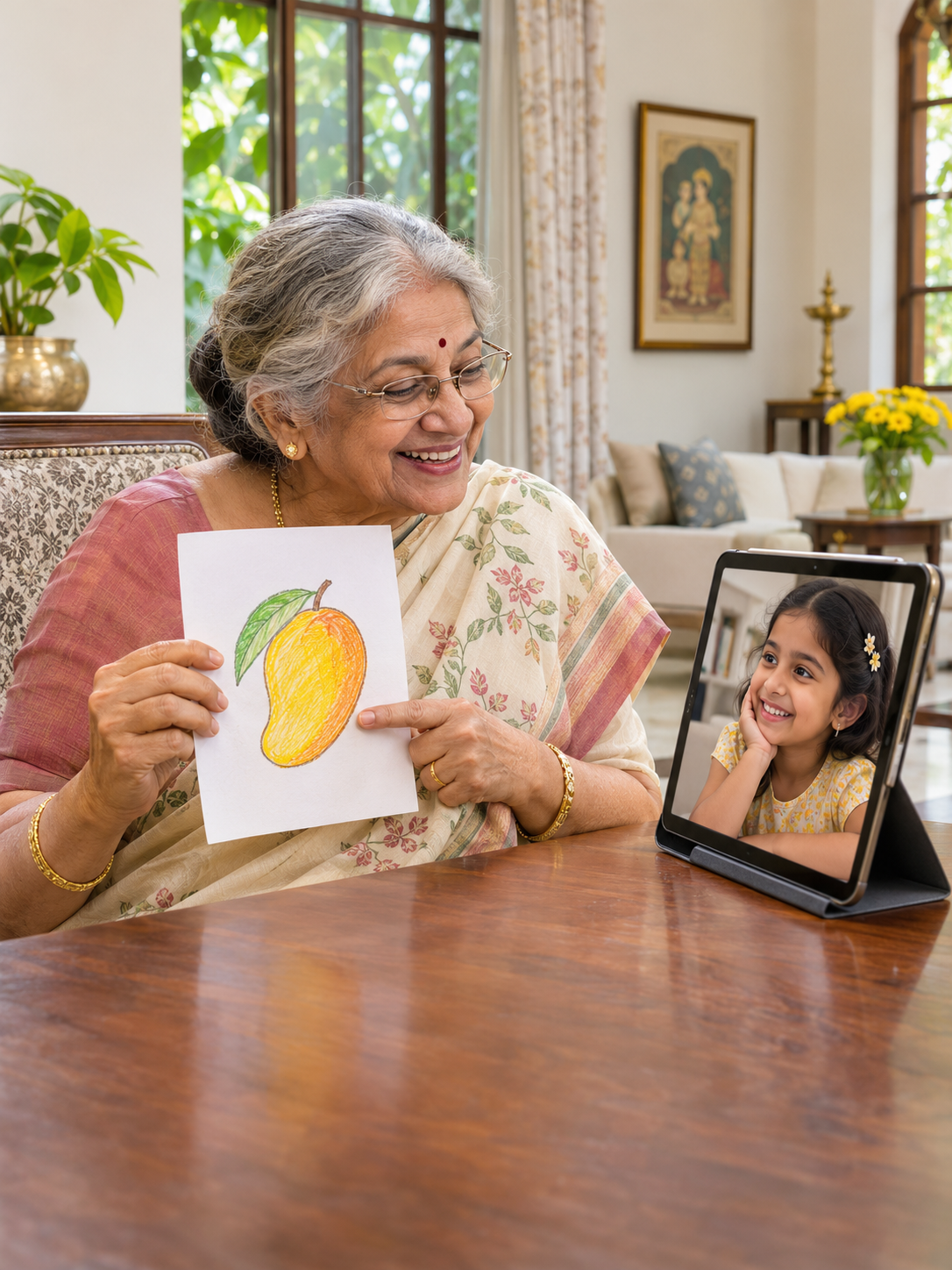
In many NRI families, the video call with the grandparents goes the same way every week: “Say hi to Nani!”, a wave, a few shy words, and the child is off to play. It isn’t anyone’s fault. They just don’t have much to talk about yet. The fix is simple: stop asking the grandparent to be an audience, and give them a class to teach.
17 months
In a US study, toddlers who had live video chats with a new adult recognised and preferred that person a week later, from about 17 months of age. Children who only watched a recording of the same person did not. A live, two-way call counts.
|
|
"What the call is missing is not love. It is something to do."
Edition 26
|
|
Picture a Sunday call. In Bangalore, Nani has been ready for twenty minutes, phone propped against the fruit bowl. In Toronto, a seven-year-old is pulled away from his Lego. “Say hi to Nani!” He says hi. She asks how school was. “Good.” She asks what he ate. “Pasta.” He holds up a drawing, a little too close to the camera, and drifts away. The parents take over and the call becomes a chat between adults.
Nobody did anything wrong. The child speaks mostly English, Nani is most at home in Hindi or Kannada, and “how was school” is a hard question for any seven-year-old. What the call is missing is not love. It is something to do.
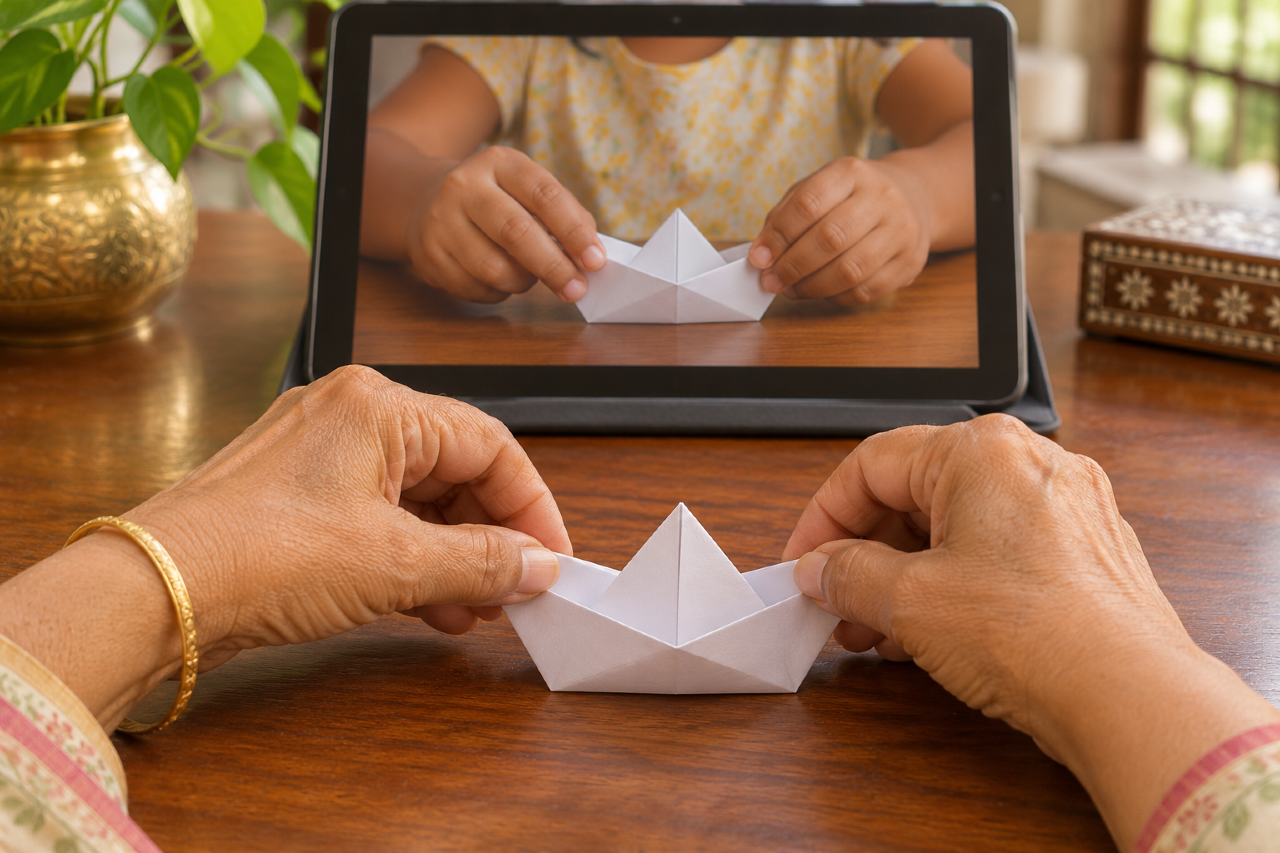
Here is a small idea that works surprisingly well: turn the weekly call into a short class, and make the grandparent the teacher. Fifteen minutes, same time each week, one small thing to learn. Ten words in the family language. One story from when Nani was small. How to fold a paper boat. Why the tulsi plant is in the courtyard. The first verse of a song she used to sing. A rangoli pattern drawn slowly, step by step, while the child copies it on paper.
Children are good at this, even very young ones. In a US study, toddlers had a few live video chats with a friendly adult who taught them new words and actions. A week later, the children recognised that adult, preferred them, and had learned more of the new patterns than children who had only watched a recorded video of the same person. The oldest toddlers in the study also picked up more of the new words. The detail that matters is that the call was live and two-way: the adult responded to the child, and the child responded back. That is exactly what a grandparent can do.
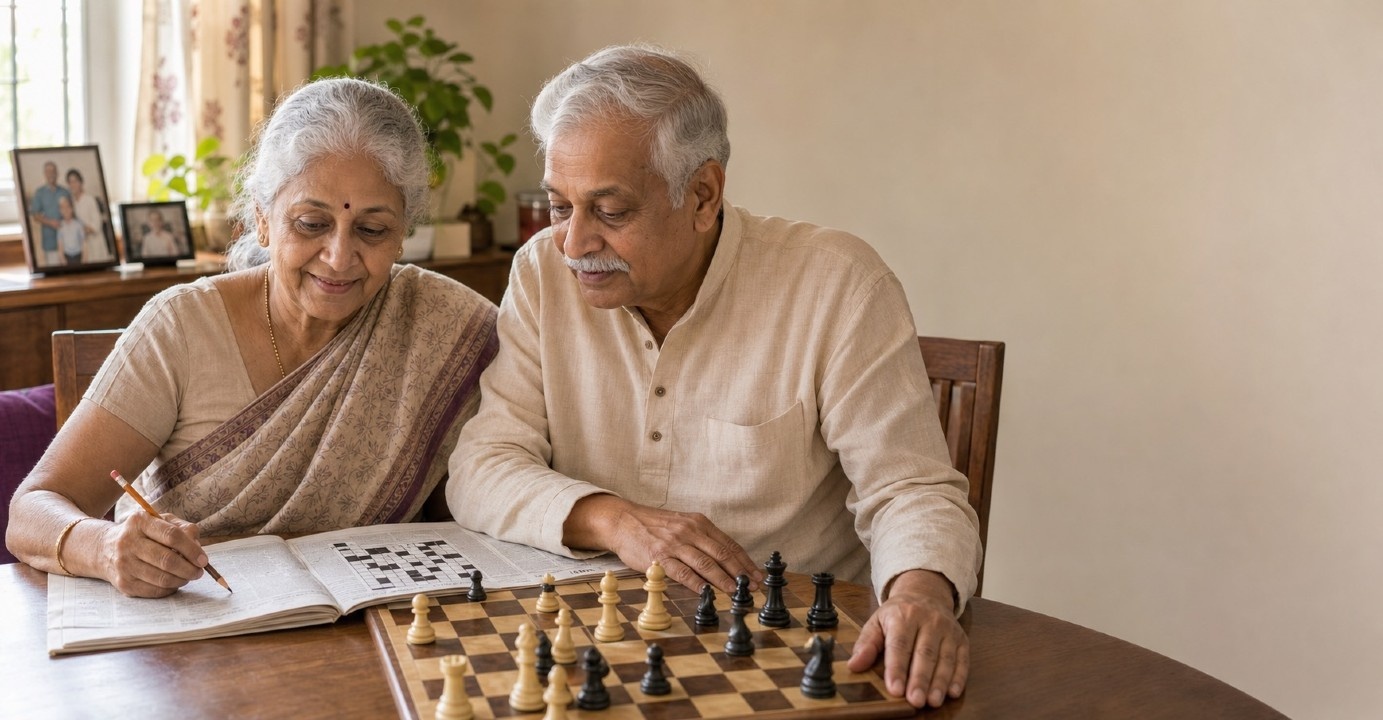
It is good for the teacher too. Preparing a lesson means remembering, planning and explaining, which is real work for the brain. In an Australian study of older women, those who looked after grandchildren about one day a week did best on thinking tests. It was a small study and shows a link, not proof, and caring for children every day did not show the same benefit. A short, regular, enjoyable role seems to be the sweet spot. A weekly class fits that well.
And then there is the language. Children who grow up abroad often understand more of the family language than they speak, and grandparents are one of the best ways to keep it going. A grandparent never gets impatient with the same word asked for the fifth time. Researchers who study families like ours say much the same thing: grandparents living back home are often a key source of the language, and of the motivation to learn it. Their part is to keep it warm and encouraging, not to correct every mistake.
The class does not have to be grand. Some weeks it will be five minutes. Some weeks the child will be tired and the class becomes Nani showing the mango tree outside. That is fine. What matters is the shape: a fixed time, a small lesson, and the grandparent in the teacher’s chair.
|
Also in this edition
"Fifteen minutes, same time each week, one small thing to learn."
The grandparent teaches; everyone else listens. And at the end, the child teaches one thing back.
This Saturday is Children’s Day: a good day for the first class.
|
|
|
● The Bangalore Lens
What's happening locally, right now
|
A Bangalore grandparent already has a lifetime of lessons. Usually the only thing missing is a working setup on their side.
Bangalore homes often hold three or four languages at once, and our parents carry stories, songs, recipes and festival customs that no app teaches. The lesson plan is the easy part. The harder part is often practical: the phone at a strange angle, the volume too low, the Wi-Fi that drops in the bedroom, and a parent who feels shy on camera and lets the call slip.
A little setup on the Bangalore end goes a long way. A tablet on a stand at eye level, good light from the front, the call saved as one tap on the home screen, and a fixed slot on the calendar. Once that is in place, most grandparents settle into the class within two or three weeks.

A Genie can help with the Bangalore side. Phone, app and TV setup gets the tablet, stand, volume and video calling working properly, with a simple one-tap way to join. Check-in and companionship can sit beside your parent for the first few classes until they feel at ease.
A Genie never touches your parent's money, never asks for a PIN, never transacts, and never signs anything on their behalf. The things you'd do for your parents, if you were here.
For daily tips and follow-along videos in local languages, your parent can join our free Active Age WhatsApp community.
|
15 min
One short class a week, at the same time, is enough. Regular beats long.
|
|
|
● One Thing To Do
This week
|
|
Action
Children’s Day, Saturday 14 November
Start Nani’s Class This Children’s Day
1. Ask the grandparent what they would like to teach. Not “can you talk to him”, but “what would you love her to learn from you?” Give them a few days to plan.
2. Fix one slot. Same day, same time, every week, and pick a time that works across time zones. Put it on both calendars.
3. Plan the first four classes together. For example: ten words in the family language, one childhood story, one song or shloka, one simple recipe step or rangoli.
4. Keep it short and hands-on. Fifteen minutes. Give the child something to do: repeat, draw, copy, show back.
5. Let the child teach back. At the end, the child teaches Nani one thing too: a word in their school language, a game, a drawing. A two-way class keeps both sides keen.
|
|
● From The Blog
Further reading on kareverse.com
|
|
|
|
We often worry that distance will make our children strangers to their grandparents. It doesn’t have to. The grandparents have the stories, the songs and the words. The children have curiosity. All that is needed in between is a regular time, a working screen and a small lesson. Give Nani the class, and let her teach.
The Kin Letter, Edition 26 · Thursday, 12th November 2026
|
|
Know someone whose parents are in Bangalore? Forward this letter, or invite them to subscribe.
Subscribe
Join Active Age Community
Follow on LinkedIn
|
|
Sources: Toddlers and live video chat: Myers LJ, LeWitt RB, Gallo RE, Maselli NM, “Baby FaceTime: can toddlers learn from online video chat?,” Developmental Science, 2017;20(4):e12430 (children aged 12–25 months; live FaceTime vs pre-recorded video of the same partner over one week; recognition and preference from about 17 months; no in-person comparison group). Grandparenting and thinking skills: Burn KF, Henderson VW, Ames D, Dennerstein L, Szoeke C, “Role of grandparenting in postmenopausal women’s cognitive health,” Menopause, 2014;21(10):1069–1074 (186 Australian women, Women’s Healthy Aging Project; one day a week linked to the best scores, five or more days a week to lower working memory and processing speed; an association, not proof of cause). Grandparents and heritage language: family language policy research on grandparents in the country of origin as a source of language input and motivation. General information, not medical advice.
You're receiving The Kin Letter because you're part of our community. Unsubscribe
|
|