| No. 22 · Thursday, 15th October 2026 |
For those who care from a distance |
Kareverse, Bangalore |
|
|
Newsletter
Elder care intelligence for NRI families with parents in Bangalore
|
|
Feature Essay
The One Who Never Gets a Day Off
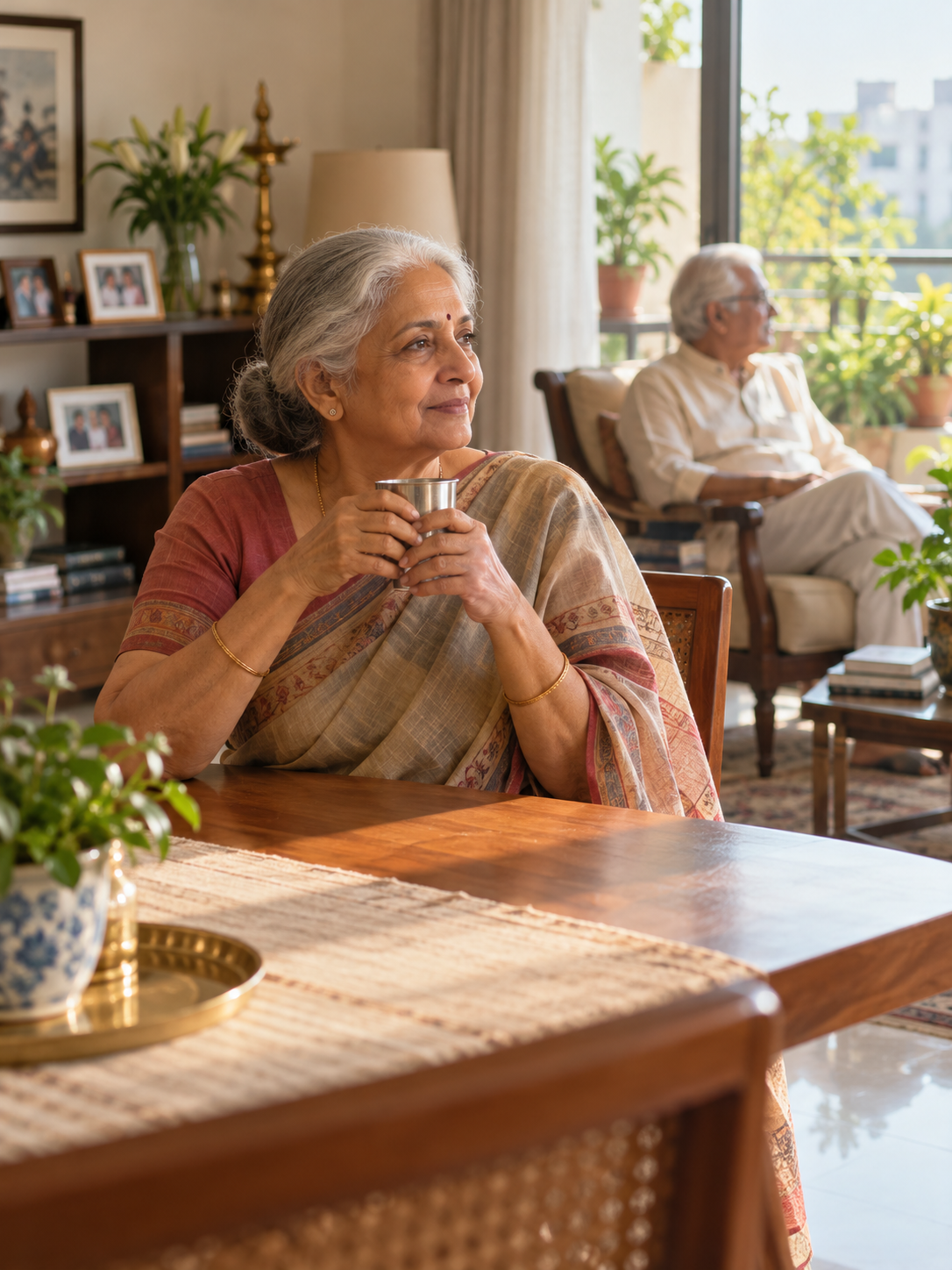
When your father starts forgetting, the whole family turns towards him: the scans, the doctor, the new tablets. But someone is with him every hour of every day, answering the same question for the tenth time, staying awake when he wanders at night, and saying "we're managing" on every call. Often it is your mother. And nobody is asking how she is.
70%
of informal care hours for people living with dementia worldwide are provided by women (WHO).
|
|
"Looking after the carer is not a kindness on the side. It is the care plan."
Edition 22
|
|
Here is how most of our calls go once a parent has dementia. We ask about Appa. Did he eat? Is he sleeping? What did the doctor say? Is the new tablet helping? Then Amma comes on the line and says everything is fine, and we hang up feeling, for a moment, that things are under control.
They are under control because of her. In India, dementia care is still predominantly provided by families at home. Often the person doing it is a spouse or another family member, sometimes an older adult managing health problems of their own: their own blood pressure, their own knees, their own tablets. They have quietly become a full-time carer without anyone deciding it. No shift ends. There is no weekend. The same question is answered ten times before lunch. Sleep comes in pieces because he gets up at 2 am, confused, and tries to leave the house. She can't go to the temple, or her friend's house, or her own doctor, because who will sit with him?
From abroad, all of this is invisible. On a video call you see your father, who may look surprisingly well for a few minutes, and your mother, who has put on a fresh saree and a brave face for exactly those few minutes. What you don't see is the slow wear: the meals she skips because she eats standing up, the check-up she has postponed three times, the friends she has stopped calling, the short temper she is ashamed of, the tiredness that has stopped lifting.
That wear is real, and it is measurable. Across research on family carers of people with dementia, depression is far more common than many families realise. A meta-analysis of 43 studies involving more than 16,000 carers estimated that about 31% had depression. In a 2023 study of 136 dementia carers in West Bengal, husbands and wives caring for a spouse reported more anxiety and depressive symptoms than other family carers. The person holding everything together may be carrying a serious health burden of their own.
Which brings us to the hard truth at the centre of this letter. The whole arrangement rests on one person. If your mother has a fall, a hospital admission or simply breaks down from exhaustion, the care of your father doesn't get a bit harder. It collapses, overnight, and you are on a 2 am flight trying to rebuild it from scratch. Looking after the carer is not a kindness on the side. It is the care plan.
And she will not ask. For many parents of that generation, looking after a husband or wife is simply what you do, and needing help feels like failing. "We're managing" is not a status report. It is a sentence designed to stop you worrying. So the question has to come from you, and the help has to be arranged by you, in a way that doesn't make her feel she has given up.
|
Also in this edition
"‘We’re managing’ is not a status report. It is a sentence designed to stop you worrying."
The parent doing the caring is often the one skipping meals, postponing their own check-ups and quietly running out of strength.
This week: ask about them first, then give them back a few hours that are theirs.
|
|
|
● The Bangalore Lens
What's happening locally, right now
|
In a city full of hospitals, the thing the caring parent most needs is not a specialist. It is three hours to themselves.
Bangalore has neurologists, memory clinics and specialist dementia services, including a few dementia day-care centres. What many families still struggle to find is regular respite: someone dependable who can share the load for a few hours so the caring spouse can attend to their own life. Respite options remain limited relative to the need, extended family is often in another city, and a parent who becomes anxious with strangers makes the carer even more reluctant to leave. So the carer stays, week after week, and their own world shrinks to the four walls of the flat.
The fix doesn't have to be dramatic. A familiar, steady person who comes at the same time each week, a ride to the carer's own doctor, and a reason to get out and see people can be the difference between a carer who copes and one who quietly breaks. Our free Active Age WhatsApp community helps with that last part: daily tips and exercise videos for older adults, so the carer still has something that is just for them.

Genie's Go With Them takes the caring parent to their own appointments, the doctor, the dentist, the eye check they keep postponing, and brings them home with a clear note for you. If the parent with dementia needs someone with them while the carer steps out, Kareverse can arrange a trained caretaker, for a few hours or for ongoing daily support.
A Genie never touches your parent's money, never asks for a PIN, never transacts. The things you'd do for your parents, if you were here.
You can't take a shift from where you are. But you can make sure someone does.
|
8.8 million
Indians aged 60+ were estimated to be living with dementia in the nationally representative LASI-DAD study published in 2023. In India, much of their day-to-day care is provided by families at home.
|
|
|
● One Thing To Do
This week
|
|
Action
On your next call
Give the Carer One Protected Break a Week
This week, on your next call, make the conversation about the parent who is doing the caring.
1. Ask them, by name, how they are. Not "how's Appa?" but "Amma, how are you sleeping? When did you last go out on your own?" Then wait, and listen past the "I'm fine."
2. Put one break on the calendar. A fixed few hours every week that belong only to the carer: the temple, a friend, a walk, a nap. Arrange who covers it, and treat it as non-negotiable, not "if things are okay."
3. Start the cover gently. If the parent with dementia is wary of new people, have the same person come while the carer is still at home for the first few visits, so the face becomes familiar before the carer steps out.
4. Book the carer's own check-up. Find out which appointments they have postponed, and get the most overdue one booked this month.
5. Watch for the warning signs. Skipped meals, a cancelled routine, unusual irritability or tearfulness, weight loss, saying "I can't leave him even for an hour." Any of these means the carer needs more support now, not later. If their mood stays low for weeks, a doctor's visit is worth it.
If you are at an earlier stage and only wondering whether something is wrong, our online Memory and Thinking Check is a simple, respectful screening you and your parent can do together. It is not a diagnosis.
|
|
● From The Blog
Further reading on kareverse.com
|
|
|
|
When we worry about a parent with dementia, we picture the forgetting. We rarely picture the other person in the room, the one who remembers everything for both of them: the tablets, the appointments, the names, the way he likes his coffee. They have taken on the hardest job in the family without applying for it and without a day off. They will not ask for help, because in their minds this is simply love. Your job, from wherever you are, is to make sure that love doesn't cost them their own health. Ask about them first. Then give them back a few hours that are theirs.
The Kin Letter, Edition 22 · Thursday, 15th October 2026
|
|
Know someone whose parents are in Bangalore? Forward this letter, or invite them to subscribe.
Subscribe
Join Active Age Community
Follow on LinkedIn
|
|
Sources: Women and dementia care: World Health Organization, Global status report on the public health response to dementia (2021) (women provide about 70% of informal dementia care hours worldwide). Family care in India: Caregivers' experiences, challenges, and needs in caring for people with dementia in India: a scoping review (2024) (care remains predominantly family-based; formal support and respite limited); Dementia caregiving in India: new evidence from a nationally representative sample (LASI-DAD, 2025). Dementia in India: Lee J et al., "Prevalence of dementia in India: National and state estimates from a nationwide study," Alzheimer's & Dementia, 2023 (LASI-DAD, data collected 2018 to 2020; an estimated 7.4% of adults aged 60 and over, about 8.8 million people). Carer depression: Collins RN, Kishita N, "Prevalence of depression and burden among informal care-givers of people with dementia: a meta-analysis," Ageing & Society, 2019 (43 studies, 16,911 carers; pooled depression prevalence 31.24%). Spouse carers in India: Basu I, Mukhopadhyay S, "Relationship Matters in Dementia Caregiving: A Comparative Study in West Bengal, India," 2023 (136 carers, 76 spouses). And Genie by Kareverse (kareverse.com/genie). This letter is general information, not medical advice.
You're receiving The Kin Letter because you're part of our community. Unsubscribe
|
|