| No. 21 · Thursday, 8th October 2026 |
For those who care from a distance |
Kareverse, Bangalore |
|
|
Newsletter
Elder care intelligence for NRI families with parents in Bangalore
|
|
Feature Essay
The Prayer Routine That's Also a Health Practice
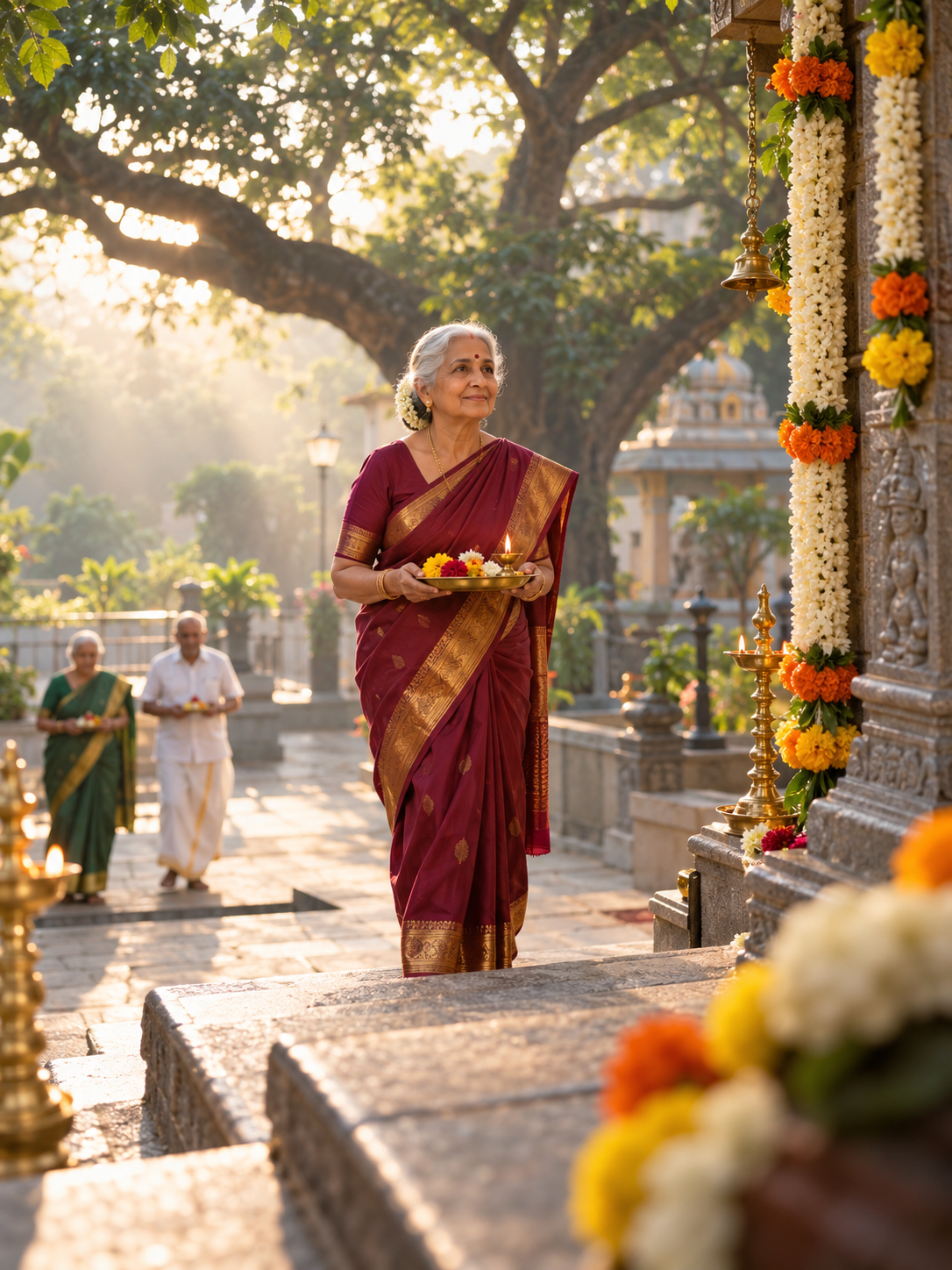
Your parent is up before dawn, walks to the temple, climbs its steps, greets the same people, chants, comes home and lights the lamp. From abroad it can look like habit, or something we have outgrown. Look again and it is a daily bundle of the very things doctors keep prescribing to older people: movement, a fixed rhythm, slow breathing, memory work and company.
33%
lower risk of dying over sixteen years among women who attended religious services more than once a week, compared with those who never attended, in a Harvard study of nearly 75,000 women.
|
|
"Our job is not to believe what they believe. It is to make sure nothing quietly takes it away."
Edition 21
|
|
Many of us left home with a quiet, affectionate scepticism about our parents' religious routines. The 5:30 alarm for the temple. The fasts. The same verses chanted every evening for as long as we can remember. We love them for it, but somewhere along the way we filed it under "tradition," something they do out of habit rather than for any benefit. And sometimes, gently, we try to talk them out of it: skip the fast, it's not good for your sugar; don't go in this crowd; why walk all that way, just pray at home.
It is worth looking at that routine the way a doctor would, setting belief aside for a moment. The walk to the temple is daily movement, often in morning light. The steps, the uneven floors and the standing and sitting are balance practice. The same faces at the same hour are a social network that checks on your parent without being asked, and notices when they don't turn up. Chanting and reciting verses from memory exercise recall and attention. Slow, rhythmic recitation changes breathing. And a fixed daily schedule of waking, prayer and meals anchors the body clock in a stage of life when retirement has removed almost every other anchor. Very few programmes designed for healthy ageing manage to combine all of that, every single day, for free.
The research, while it has limits, points the same way. A large Harvard study that followed nearly 75,000 American nurses for sixteen years found that women who attended religious services more than once a week had a 33% lower risk of dying during that period than women who never attended, with lower rates of death from both heart disease and cancer. The researchers pointed to less depression, less smoking, more social support and more optimism as part of the reason. Other studies in older adults have linked regular attendance to better cognitive function and, in some groups, lower odds of dementia. And a well-known study in the BMJ found that reciting either a rosary prayer or a yoga mantra naturally slowed breathing to about six breaths a minute, a rhythm that measurably improved the body's blood-pressure regulation.
Honesty matters here. These are mostly observational studies, and healthier, more mobile people are more able to attend in the first place, so no one can promise that prayer itself adds years. The fairest reading is that the whole package matters: the walk, the rhythm, the breath, the belonging. For many Indian parents, faith is simply the thing that holds that package together and gets them out of the door each morning. Whatever your own beliefs, that is worth protecting.
Which leads to the part a video call will never show you. When a parent's religious routine quietly shrinks, it is often one of the earliest signs that something else is wrong. They stop going to the temple because the steps have become frightening after a near-fall. Because they can no longer hear the priest or follow the chanting. Because their knees won't manage sitting on the floor any more. Because a friend they walked with has died, or because low mood has taken away the reason to go. "I just pray at home now" sounds peaceful. Sometimes it is. Sometimes it is the first line of a much bigger story.
|
Also in this edition
"“I just pray at home now” sounds peaceful. Sometimes it is."
When a parent's prayer routine shrinks, ask why. Frightening steps, fading hearing, sore knees, a lost companion or low mood can all hide behind it.
With Navaratri beginning on Sunday, remove the barrier, not the habit.
|
|
|
● The Bangalore Lens
What's happening locally, right now
|
Bangalore's temples, churches, mosques and gurdwaras are some of the city's best senior centres. Getting there is the hard part.
Walk past any neighbourhood temple in Malleshwaram or Basavanagudi at dawn, or a church in Frazer Town on a weekday morning, and you will see who keeps the city's places of worship running: its older residents. For them these are not only places of prayer but the one reliably social part of the day. The problem is rarely the will to go. It is the steep steps, the footwear left at the gate, the crowds at festival time, the auto that doesn't come, and a family that worries, understandably, about a fall.
With Navaratri beginning on Sunday 11 October, the next ten days are when many parents most want to go, and when crowds and long hours make it hardest. It is also a time of fasting, and for a parent on diabetes or blood-pressure tablets, a fast should always be checked with their doctor first. Our Active Age community is built on the same insight as the temple courtyard: older people do better with a rhythm, a walk and familiar faces.

Genie's Go With Them accompanies your parent to the temple, church, mosque or gurdwara, handles the auto, lends a steady arm on the steps and through the crowd, and brings them safely home, so the festival visit happens instead of being quietly given up. Genie's Be There at Home helps keep the home routine going on days they can't go out, and is the pair of eyes that notices when a morning prayer habit has started slipping.
A Genie never touches your parent's money, never asks for a PIN, never transacts. It is simply the steady arm you would offer yourself, if you were here. The things you'd do for your parents, if you were here.
You can't walk your parent up the temple steps this Navaratri. But you can make sure someone does.
|
6 /min
breaths a minute: the pace that slow, rhythmic recitation of a prayer or mantra naturally settles into, which in a BMJ study measurably improved the body's control of heart rate and blood pressure.
|
|
|
● One Thing To Do
This week
|
|
Action
Ask this week
Ask About the Routine, Not the Belief
This week, before Navaratri begins, treat your parent's prayer routine as something worth knowing about in detail.
1. Ask how it makes them feel, not why they do it. "How do you feel after the temple?" opens a warm conversation. "Why do you still do that?" closes one.
2. Ask who they go with. The friend they walk with is part of their care network. Know their name, and ideally have their number.
3. Watch for the routine shrinking. If they have stopped going, or go less, ask gently why. Steps, hearing, knees, a lost companion or low mood are all fixable or worth knowing about, and each one matters well beyond prayer.
4. Remove the barrier instead of the habit. Rather than "don't go in the crowd," arrange a ride, a companion, an off-peak time, or a nearer temple with fewer steps.
5. Check festival fasting against the medicines. If they plan to fast during Navaratri and take tablets for diabetes or blood pressure, ask their doctor how to adjust. A fast done safely keeps the tradition intact.
When you are home for the festivals, don't book plans over their prayer hour. For your parent, it may be the most important appointment of the day.
|
|
● From The Blog
Further reading on kareverse.com
|
|
|
|
We spend a lot of energy, from far away, trying to add healthy habits to our parents' lives: the walking app, the breathing exercises, the social club they never join. Often the habit is already there, built long before any of us were born, and all it needs from us is respect and a little practical help to keep going. You don't have to share your parent's faith to see what it gives them each morning. The early walk, the familiar faces, the slow breath of an old prayer. Our job is not to believe what they believe. It is to make sure nothing quietly takes it away.
The Kin Letter, Edition 21 · Thursday, 8th October 2026
|
|
Know someone whose parents are in Bangalore? Forward this letter, or invite them to subscribe.
Subscribe
Join Active Age Community
Follow on LinkedIn
|
|
Sources: Religious attendance and mortality: Li S, Stampfer MJ, Williams DR, VanderWeele TJ, "Association of Religious Service Attendance With Mortality Among Women," JAMA Internal Medicine, 2016 (Nurses' Health Study, 74,534 women followed 1996 to 2012; attendance more than once a week associated with 33% lower all-cause mortality versus never attending; depressive symptoms, smoking, social support and optimism identified as potential mediators). Religious attendance and cognition: observational studies in older adults link regular attendance with better cognitive function and slower decline in some cohorts, including a 2024 Health and Retirement Study analysis reporting higher odds of Alzheimer's and related dementias among Black older adults who never attended; some studies find no association, and the evidence is observational, not causal. Prayer, mantra and breathing: Bernardi L et al., "Effect of rosary prayer and yoga mantras on autonomic cardiovascular rhythms: comparative study," BMJ 2001;323:1446 (recitation slowed breathing to about six breaths a minute and increased baroreflex sensitivity). Festival dates: Sharad Navaratri 11 to 19 October 2026; Vijayadashami 20 October 2026. And Genie by Kareverse (kareverse.com/genie). This letter is general information, not medical advice; any fasting plan for a parent on regular medicines should be discussed with their doctor.
You're receiving The Kin Letter because you're part of our community. Unsubscribe
|
|