Kareverse
WhatsApp
All editionsNo. 07 · 2 July 2026

The Kin Letter · No. 07 · 2 July 2026

The Care Network You Should Build Before You Need It

No. 07  ·  Thursday, 2nd July 2026 For those who care from a distance Kareverse, Bangalore

Newsletter

The Kin.Letter

Elder care intelligence for NRI families with parents in Bangalore

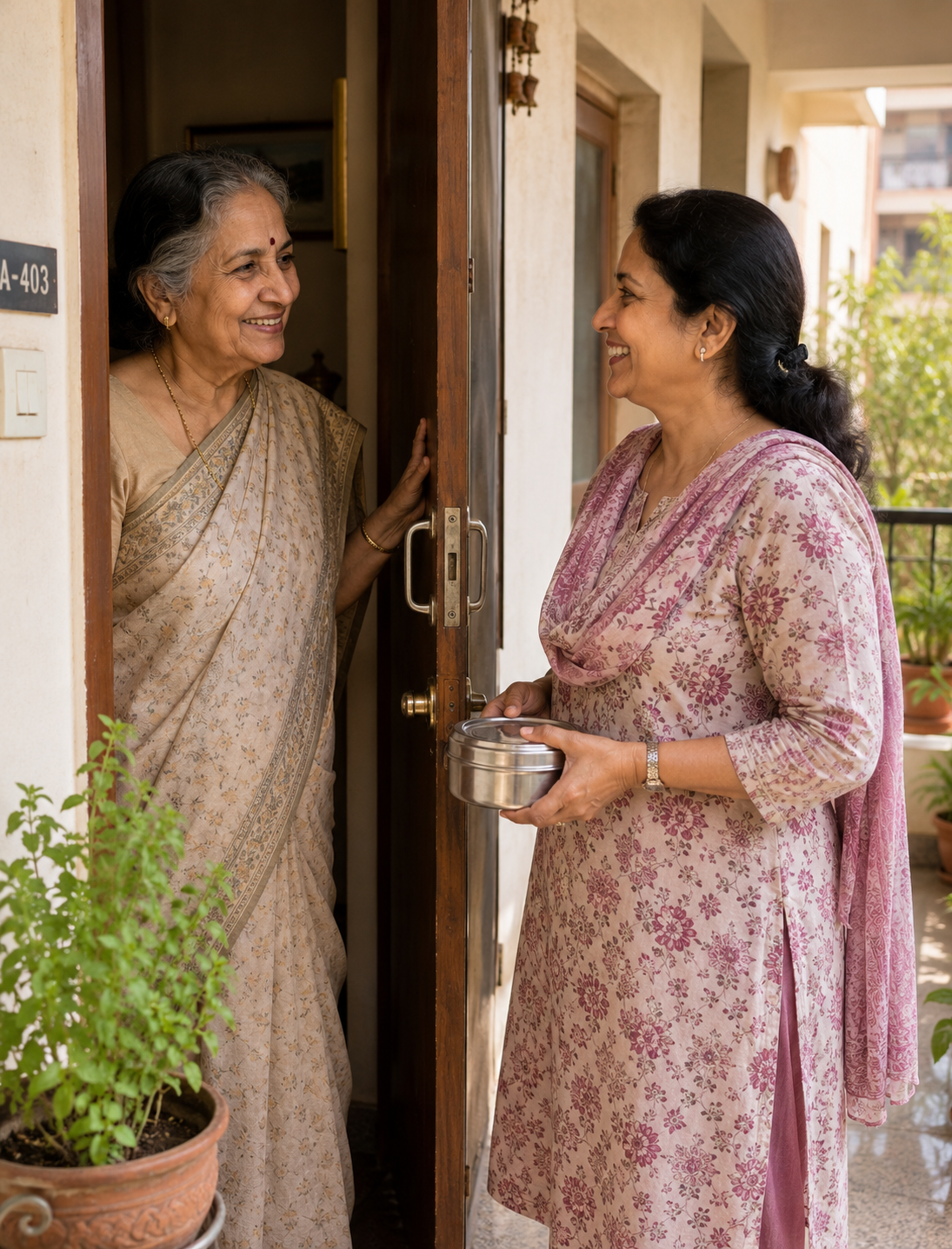
Elderly Indian parent chatting with a friendly neighbour at their apartment door in Bangalore

Feature Essay

The Care Network You Should Build Before You Need It

The best thing you can do for your parents is not buy them a medical alert pendant or sign them up for an app. It is build a local care network, deliberately, while nothing is wrong. Three people. Three layers. One ordinary afternoon.

3 people

A neighbour who notices the lights, a guard who notices the morning walk, a shopkeeper who wonders why the milk hasn't been bought. That is the whole network.

"The network isn't built in a crisis. It is built on ordinary Tuesday afternoons, when nothing is wrong, and you are still around to do the asking."
Edition 07

India's elderly population is about 10.1% of the country and climbing. Nearly 17% of elderly Indians live alone or with only a spouse. Only 7.2% of physically immobile elderly receive help from anyone outside the family. When your parents are in Bangalore and you are in California or Singapore, you are not the caregiver. You are the financier and the voice on WhatsApp. The actual care, the trip to the pharmacy at 7 PM, the lift that suddenly stops working, the dizziness after breakfast, is handled by whoever is physically present.

A recent study in BMC Geriatrics (April 2026) mapped the social networks of elderly Indians and found something quietly devastating: parents of migrated children receive financial aid and virtual emotional support from their children, but "extended family or neighbours provide physical assistance when caregivers are absent." That is the gap. And it is bridgeable.

Layer one: your neighbours. Not the people you nod at in the lift. The people who know your parents by name, know their flat number, and know yours with the country code. Knock on three or four doors. Introduce yourself. Exchange numbers. Say the sentence out loud: "My parents live in 4B. If you ever notice their lights off for a couple of days or their newspaper piling up, would you mind calling me?" Most people say yes. Almost no one is ever asked.

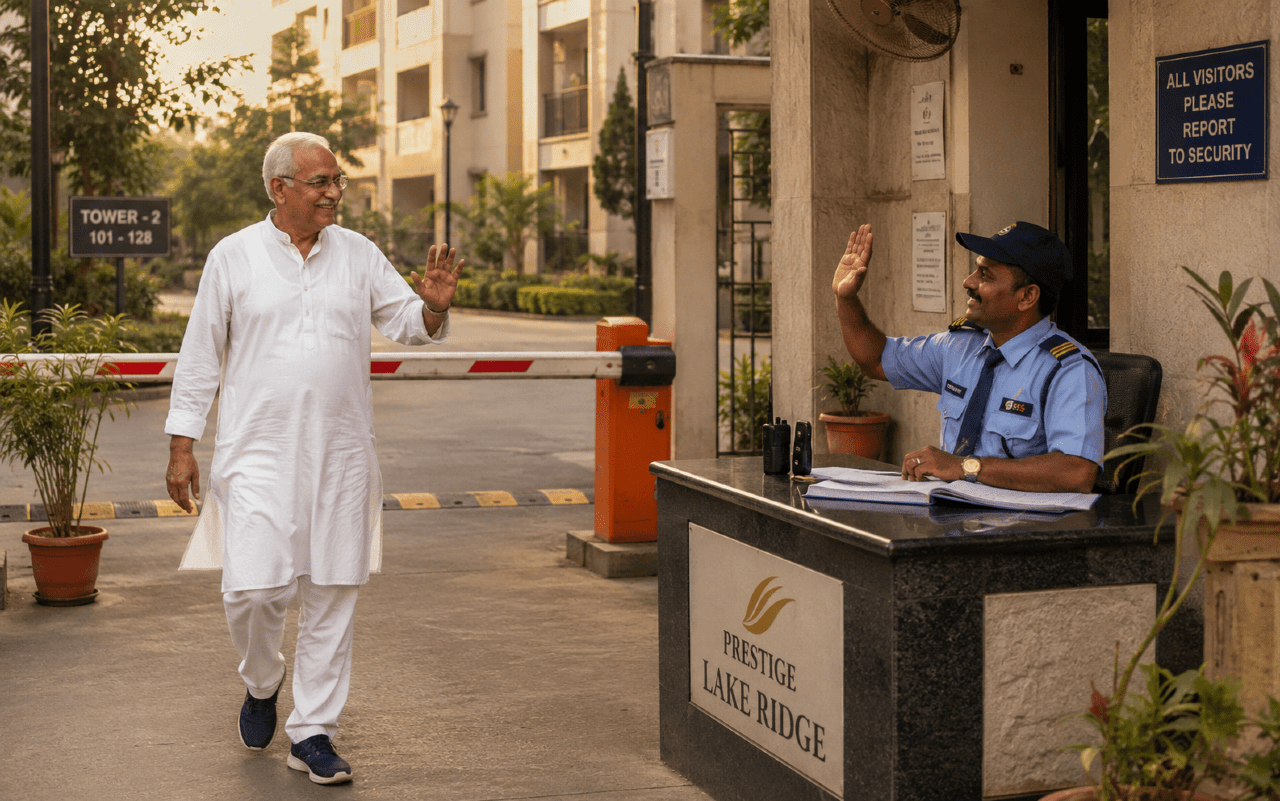
Layer two: the building staff. Security guards in Bangalore apartments are often the only people who see elderly residents daily, on morning walks, at the gate, in the lift. Introduce your parents to every guard by name, across all shifts. Give them your number and your parents' flat number. Housekeeping staff often become de facto caregivers simply by being in the flat regularly and noticing when something feels off.

Layer three: the local economy. The kirana store owner who has sold your mother rice for eight years. The pharmacy that knows her blood pressure tablet. The auto driver who takes your father to his eye check-ups. These people know your parents' routines better than anyone except your parents themselves. Visit them. Tell them: "My parents live alone at this address. If they stop coming or if you notice anything unusual, here's my number." In Indian neighbourhoods, this works. Shopkeepers are community infrastructure. They just need to know they are part of your infrastructure.

Also in this edition

Bangalore apartment security guard greeting an elderly resident

"You don't need 22,000 volunteers. You need three people who know your parents by name."

The Convoy Model study confirms that neighbours provide physical assistance when family is absent. But relationships in the "outer circle" weaken when reciprocation becomes unclear.

So maintain the network. Send the security team sweets during Diwali. Bring the neighbour a small gift from abroad. Call the shopkeeper every few months. These gestures are not charity. They are the lubricant of a functioning care system.

●  The Bangalore Lens    What's happening locally, right now

Bangalore runs on WhatsApp groups and ADDA. Your parents' care should too.

Most apartment communities in Bangalore use some combination of the ADDA app, MyGate, or plain WhatsApp groups. ADDA's "Emergency Help" feature connects residents to security and neighbours. Morning walking clubs operate across Indiranagar, Jayanagar, Malleshwaram, and Whitefield, at Cubbon Park, Lalbagh, and JP Park, usually 6:00 to 7:30 AM. These are not just exercise groups. They are daily check-in systems disguised as social clubs.

But apps and helplines answer questions. They do not notice that your father has been skipping meals, or that your mother seems less steady this month. That requires someone who was there last week and will be there next week. A Kareverse Care Manager through the Active Age programme fills exactly this gap: regular visits, familiar conversations, and the kind of observation that only comes from knowing someone over time.

17%

of elderly Indians live alone or with only a spouse. No live-in caregiver, no daily visitor. The network you build today becomes their safety net tomorrow.

●  One Thing To Do    This week

Action

Do this now

Laminate an Emergency Contact Card. Put It in Three Places.

This sounds embarrassingly simple, but it is the single most useful thing in a crisis. When your father falls and the neighbour rushes in, she needs to know his blood group and which hospital to call, without unlocking his phone or guessing his PIN.

The card should read: Your parents' names and flat number. Blood group. Your phone number with the country code. A neighbour's number. The building secretary's number. The security desk number. The family doctor's number. The nearest hospital's emergency number. That is it. No QR codes, no apps.

Put the card on the fridge, the bedside table, and in their wallet. Technology fails. Phones lock. Networks drop. A laminated card on the refrigerator does not. Build the card this week. Then go knock on three doors.

●  From The Blog    Further reading on kareverse.com
Assisted Living vs Home Care in Bangalore

Assisted Living vs Home Care in Bangalore: Which Is Right for Your Aging Parent?

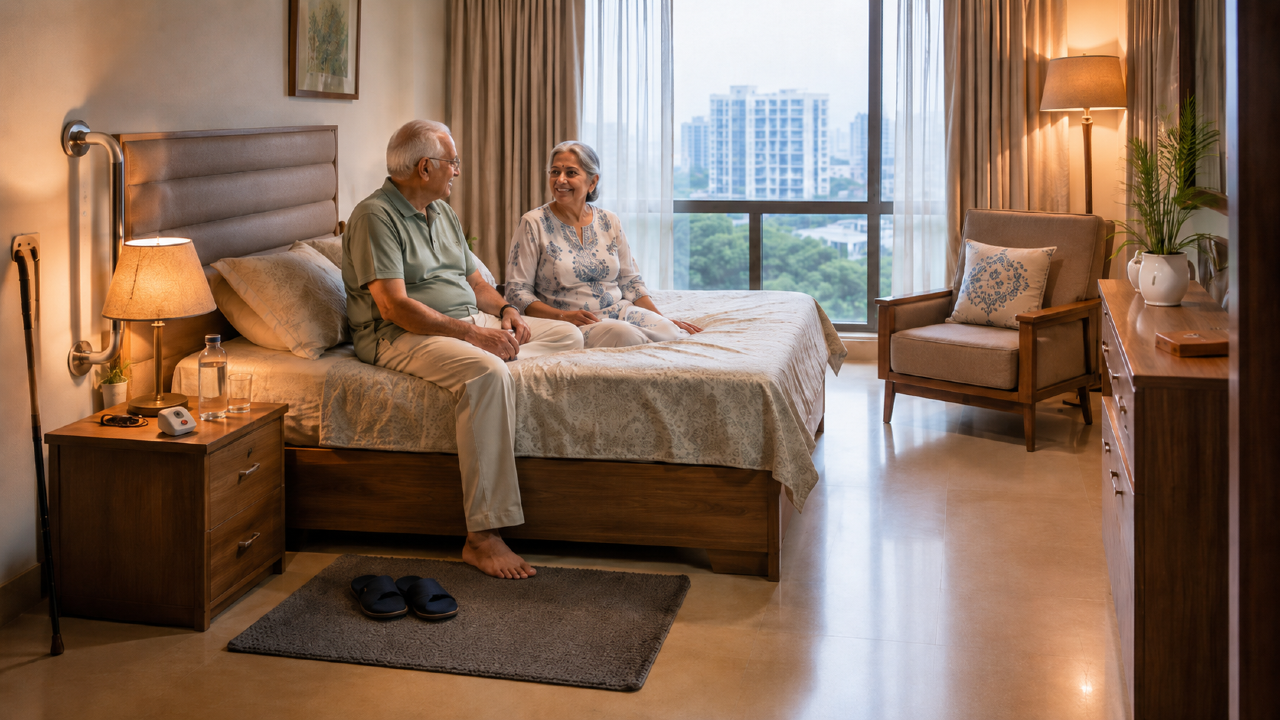
Bedroom Safety for Elderly Parents in Bangalore

How to Set Up a Safe Bedroom for Elderly Parents in a Bangalore Apartment

Bathroom Safety for Seniors in Bangalore

The Complete Guide to Bathroom Safety for Seniors in Indian Homes

You don't need 22,000 volunteers. You need three people who know your parents by name: a neighbour who notices the lights, a guard who notices the morning walk, and a shopkeeper who wonders why the milk hasn't been bought. The network isn't built in a crisis. It is built on ordinary Tuesday afternoons, when nothing is wrong, and you are still around to do the asking.

The Kin Letter, Edition 07  ·  Thursday, 2nd July 2026

Know someone whose parents are in Bangalore? Forward this letter, or invite them to subscribe.

Subscribe    Join Active Age Community

Sources: India elderly population data (Census/MOSPI), HelpAge India 2024 caregiver study (68% daily care, 20 hrs/week), BMC Geriatrics April 2026 Convoy Model study on elderly social networks, Ajmera Infinity AOA lockdown response (Times of India, 2020), Bengaluru Police Elders Helpline 1090 (Nightingales Medical Trust).

You're receiving The Kin Letter because you're part of our community. Unsubscribe

Get The Kin.Letter
in your inbox

Elder care intelligence for families with parents in Bangalore.

  • A short essay every Thursday
  • One practical thing to do
  • 5-minute read, no spam

You can unsubscribe at any time — every edition has a one-click unsubscribe link.

Get in touch